Yellowstone
Sunday, 8.10.
Chevy Schüssel is back!
- from the somewhat run-down but cheap airport hotel to the car rental: they always find something to complain about, this time they don’t accept me as driver because my driving licence is not from the same country as the passport (Switzerland and Austria): the guy behind the counter asks me if I don’t also have an Austrian driving licence- how does he imagine should that be possible? Fortunately the problem is easily solved by him adding Matthäus as driver – last time they complained about the credit card because it says “Debit” (but it works via the VISA system)
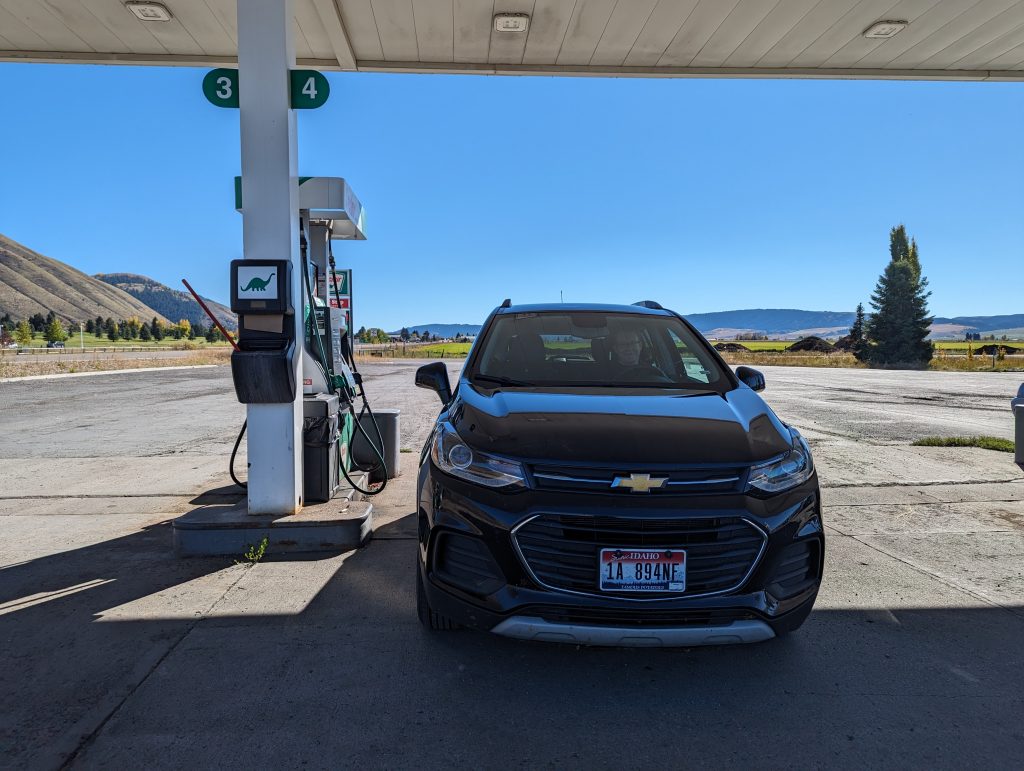
- our rental car, by the way, is the upgraded version of the previous Chevy – at least it’s a car we are a little familiar with by now, which is nice
- Stop at Walmart, where we stock up on water, a gallon of iced tea inspired by Simon and provisions for the next few days.
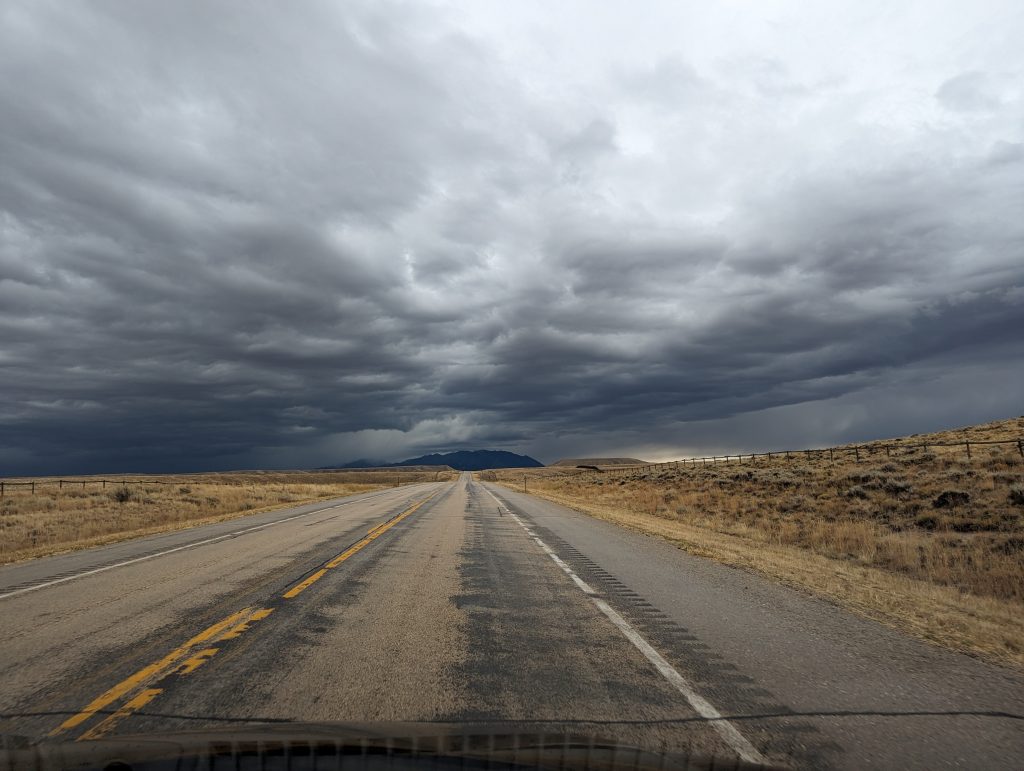
- we continue on highways through beautiful autumnal mountain and hilly landscapes towards the north – it’s road trip feeling at its best
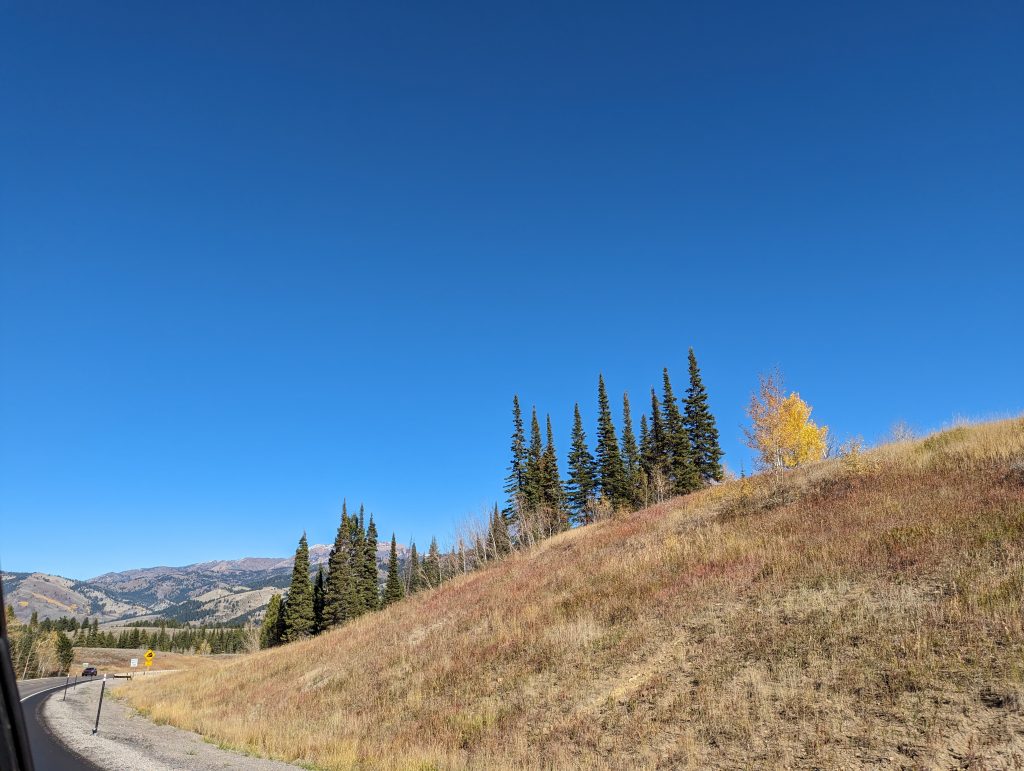
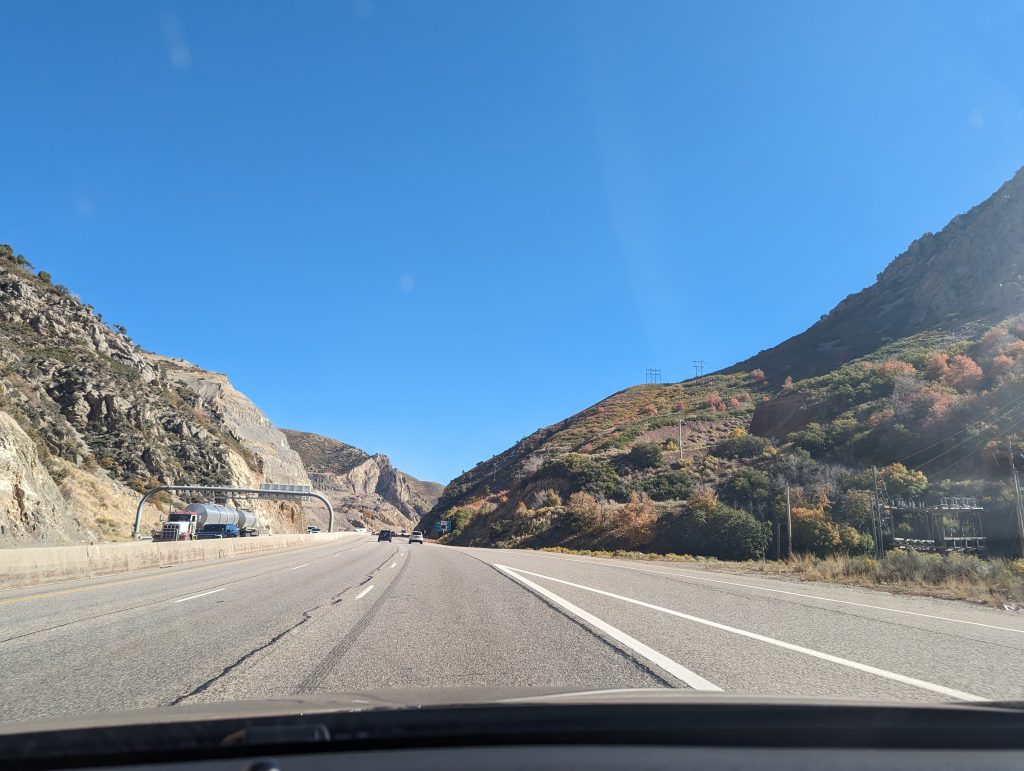
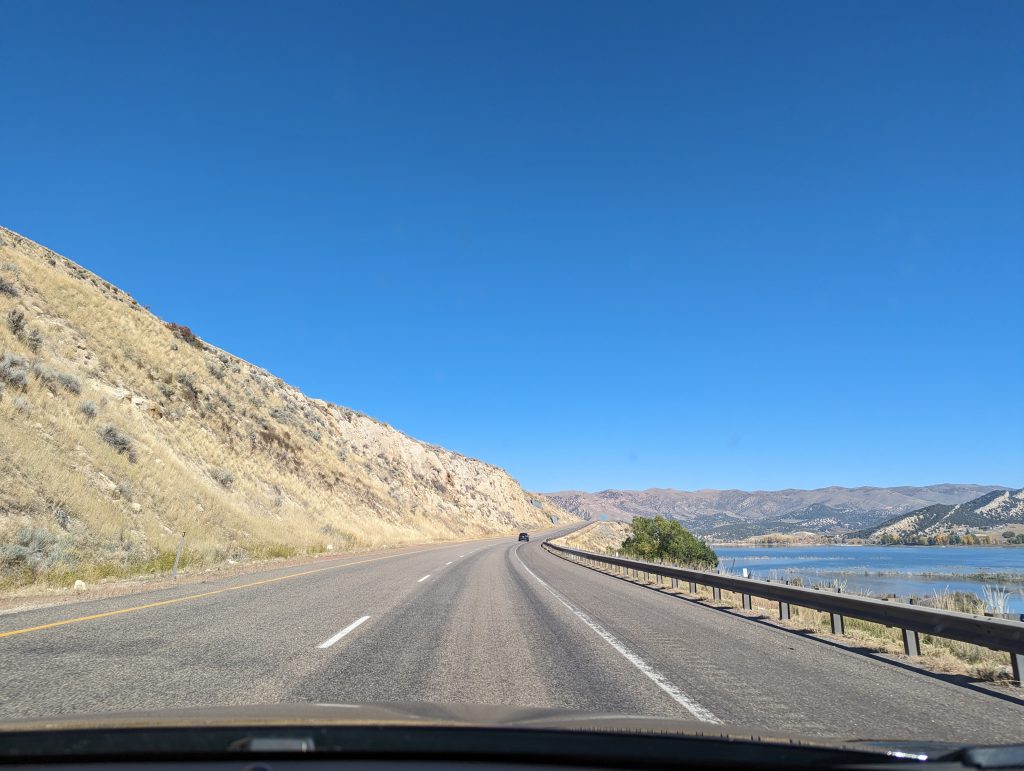
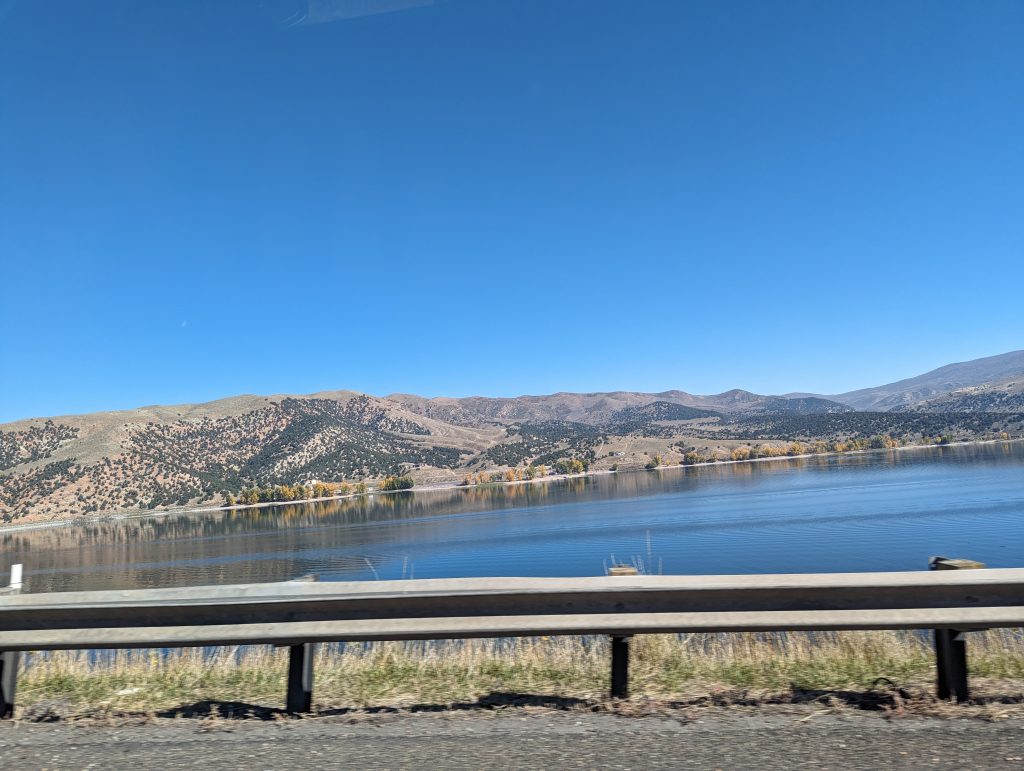
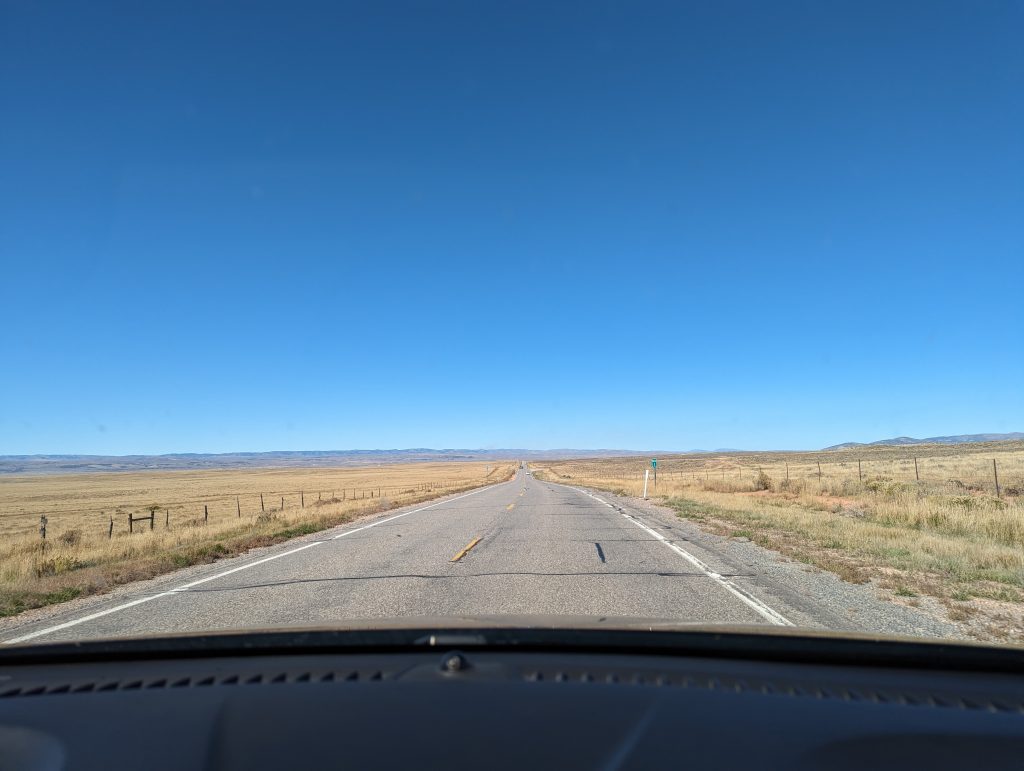
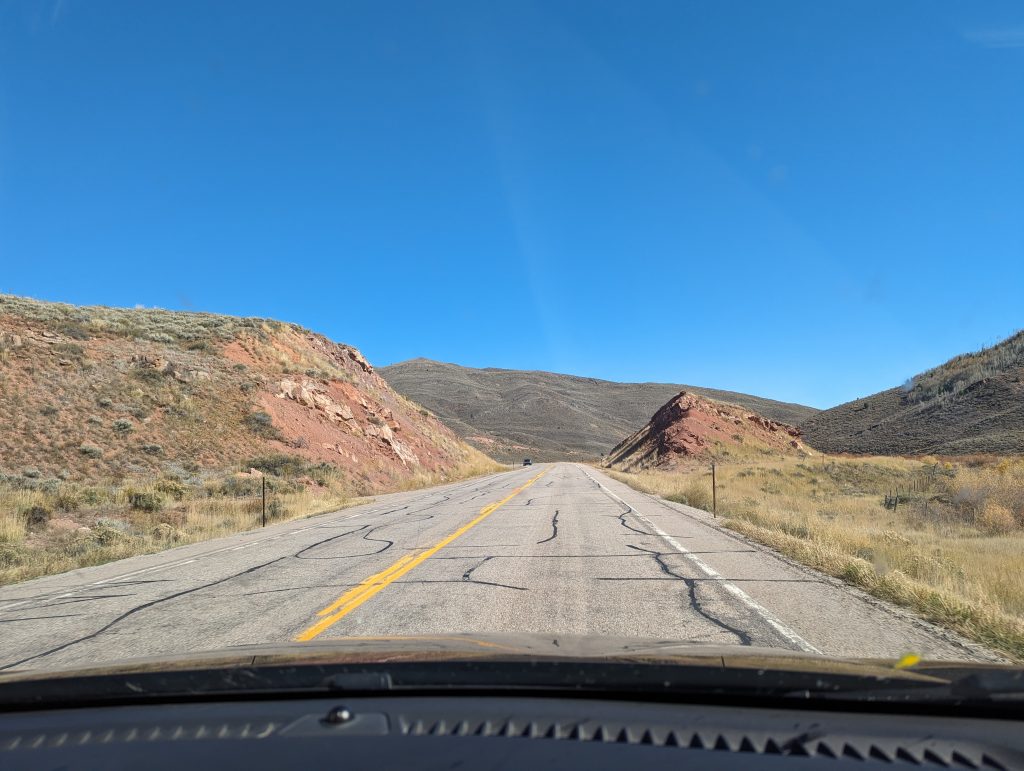
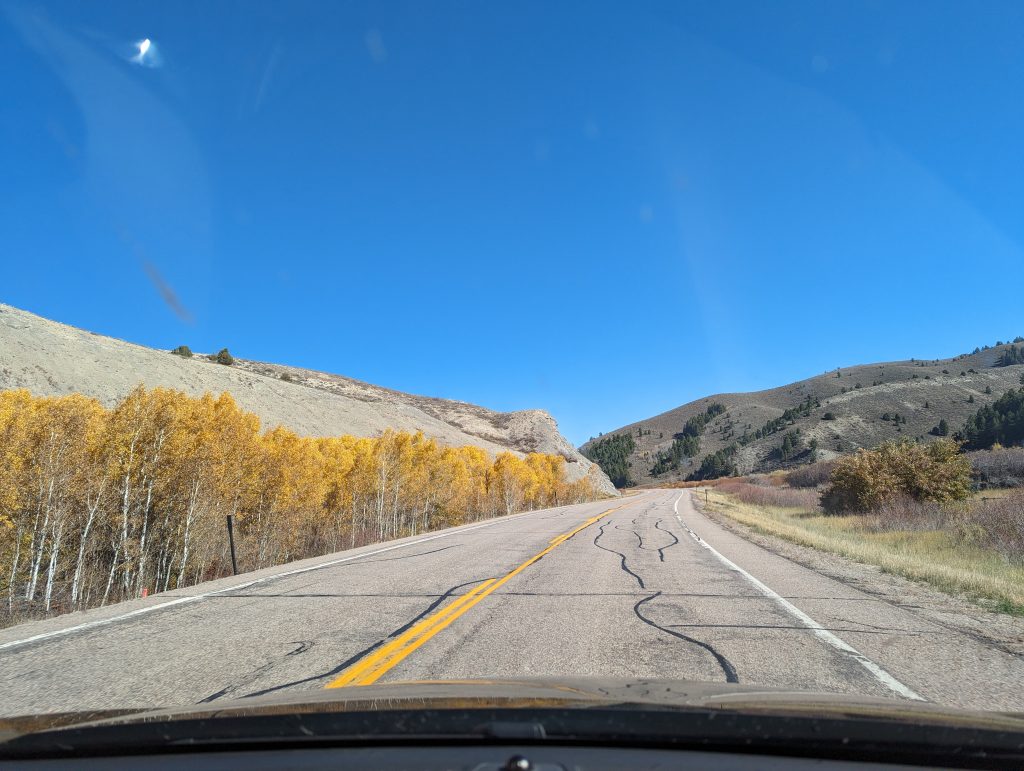
- from time to time the road crosses small villages that are fascinating – much more spread out than Austrian villages and always with a Mormon church in the middle.
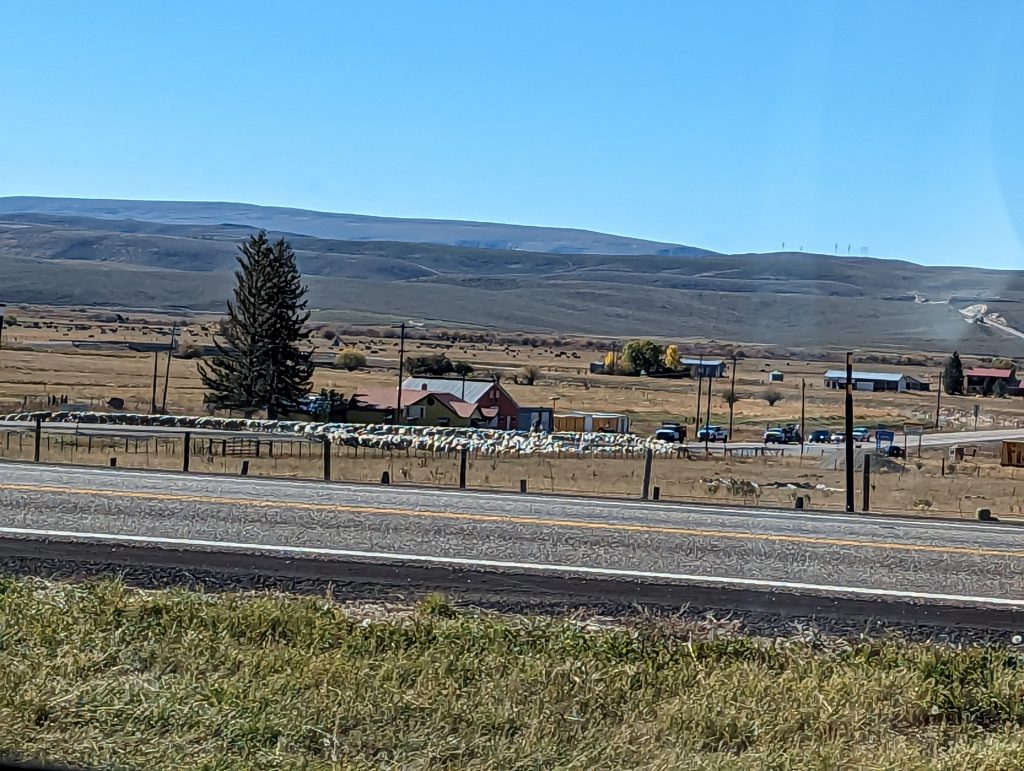
- At a crossroad where we turn right, we see a huge traffic jam on the road leading straight ahead and ask ourselves: How can it be that there is such a traffic jam here in the middle of nowhere? Well, the reason for that becomes obvious quickly: a whole herd of sheep is blocking the entire highway – what a sight!
- Soon we reach the town of Jackson (?, not Mississippi), which marks the beginning of the Grand Teton National Park
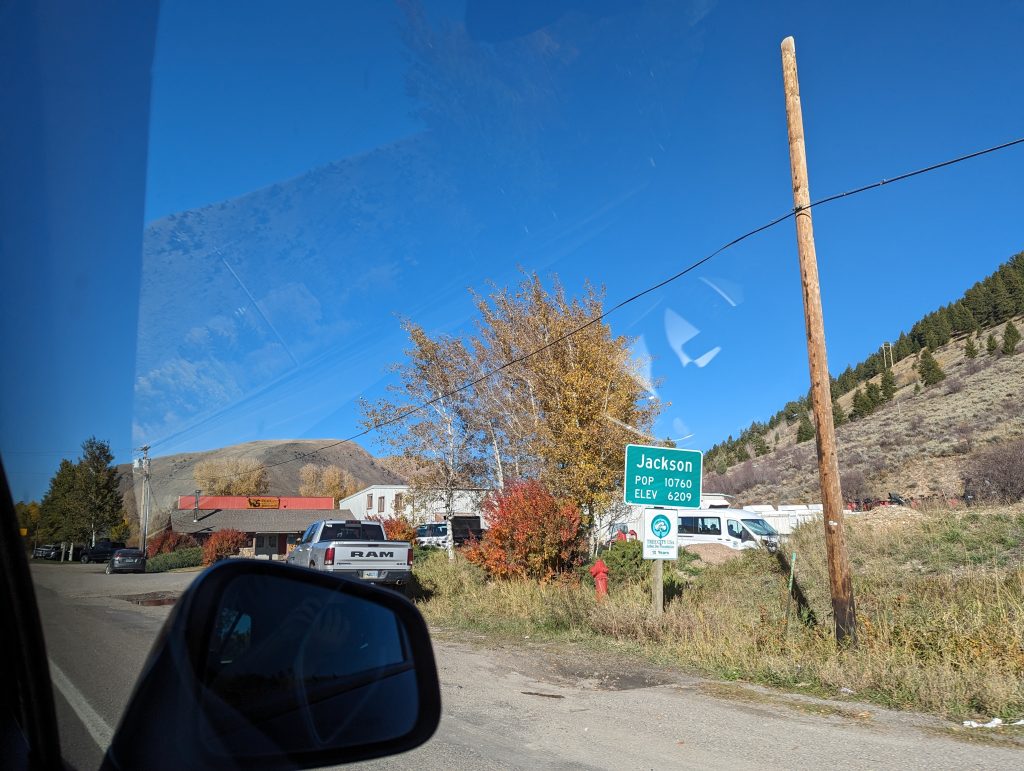
- the first stop is at the Visitor Centre, where we get both, a map and tips for short afternoon hikes (it’s already about 5 pm).
- we decide to do a “short” (“Its 1.5 Miles to the Lake only”, the employee tells us) round hike, which leads to a lake, as from there one should have very nice views of the mountain range of the Tetons
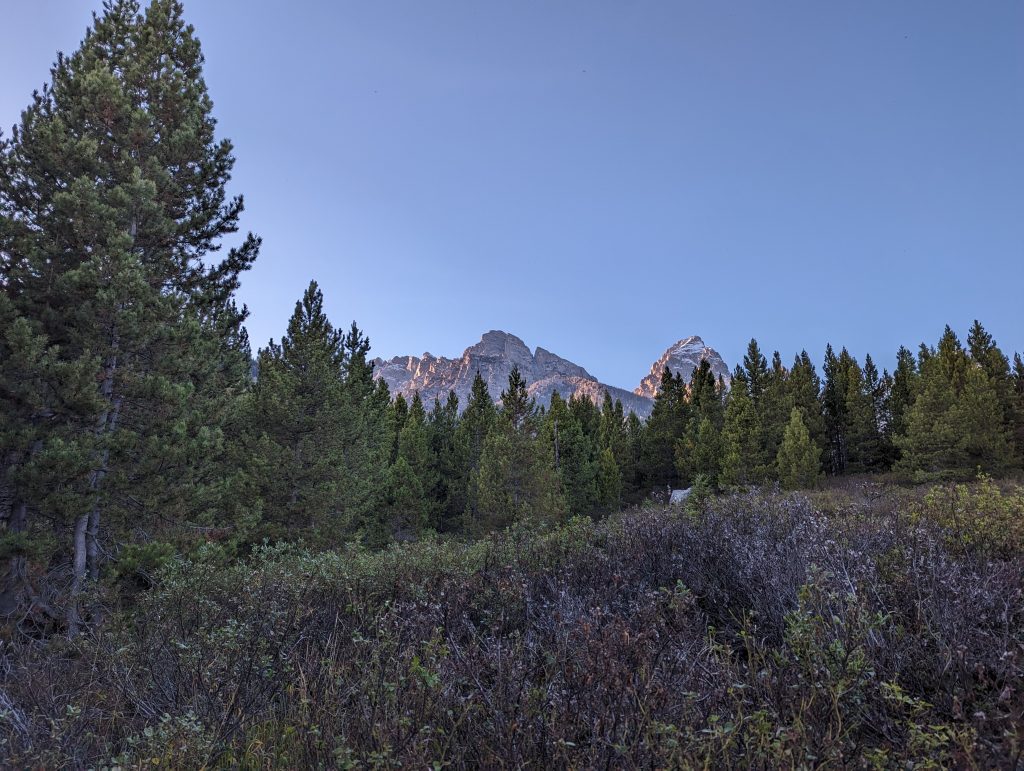
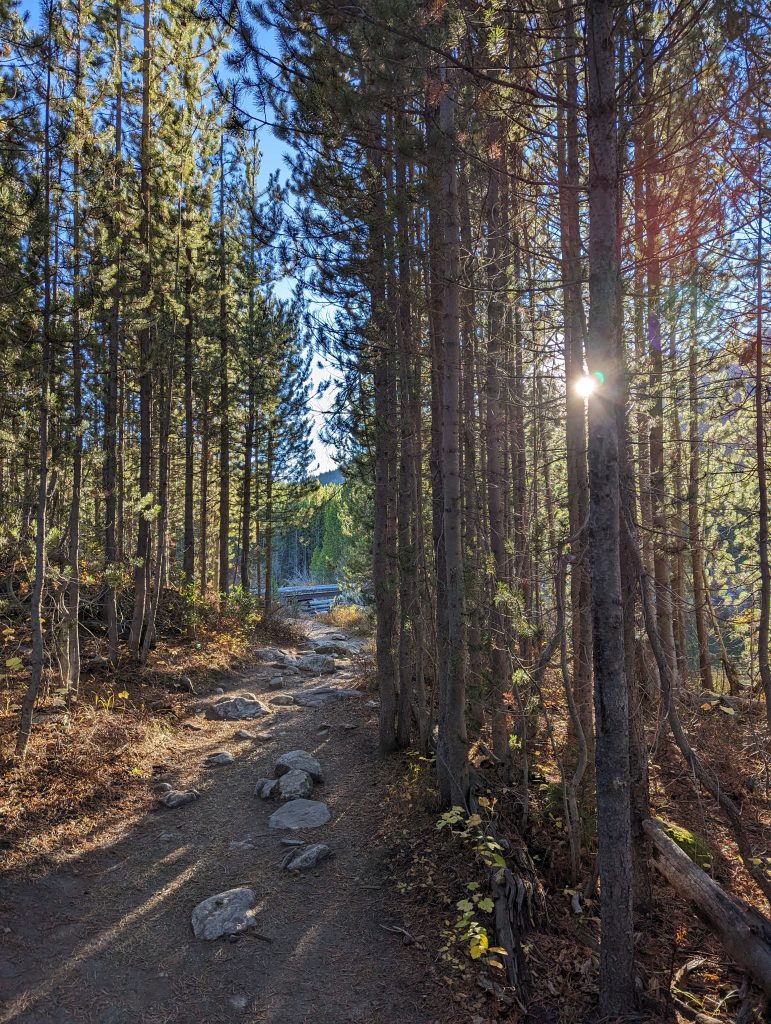
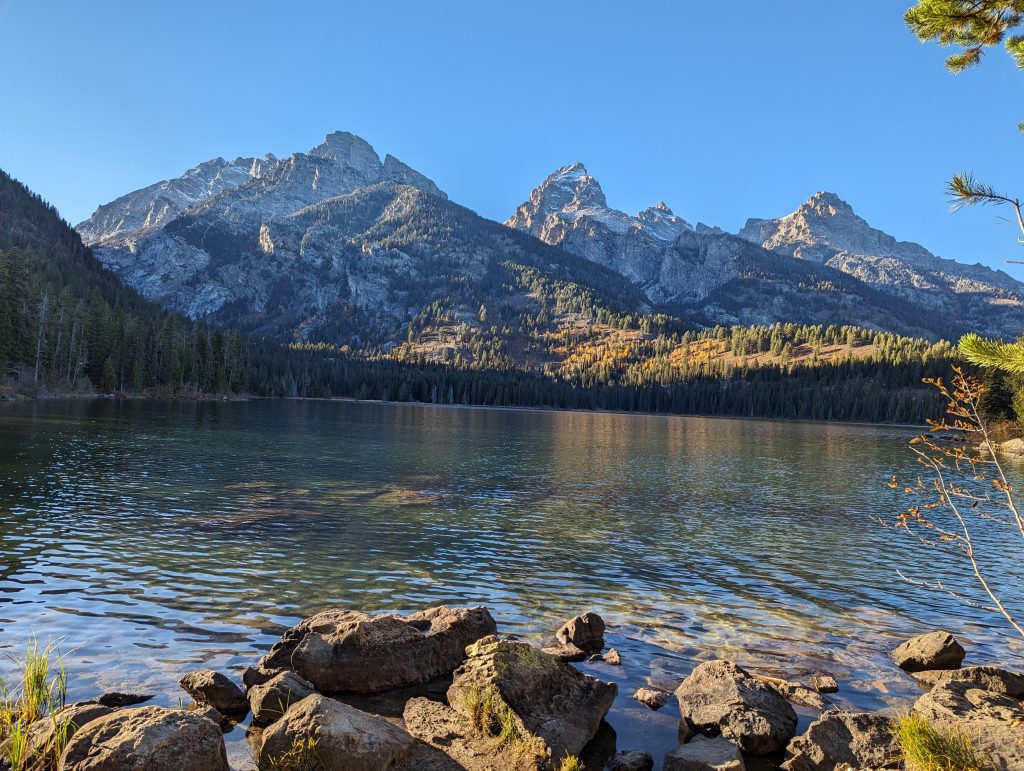
- the hike turns out to be longer than expected – in the end we walk about 8km instead of the expected 5km – but it delivers everything it promises in terms of views and beauty – it is beautifully autumnal and very picturesque: not only do you regularly have a great view of the Teton mountain range, but you can also see miles of forests stretching out in front of you, glowing in various colours
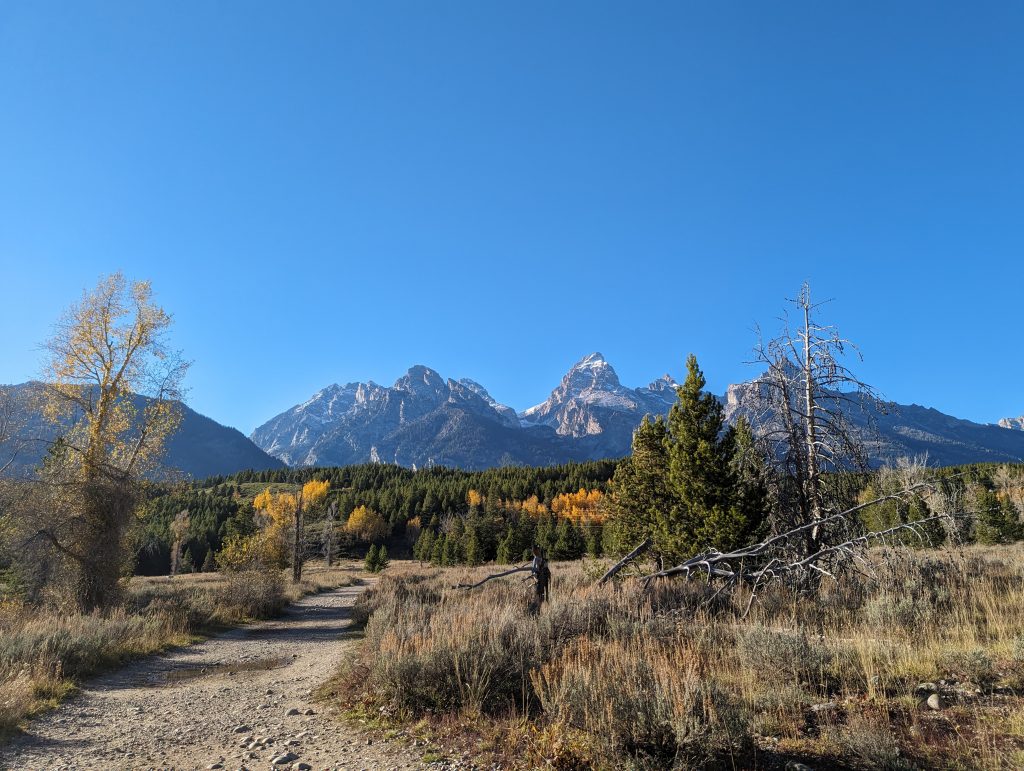
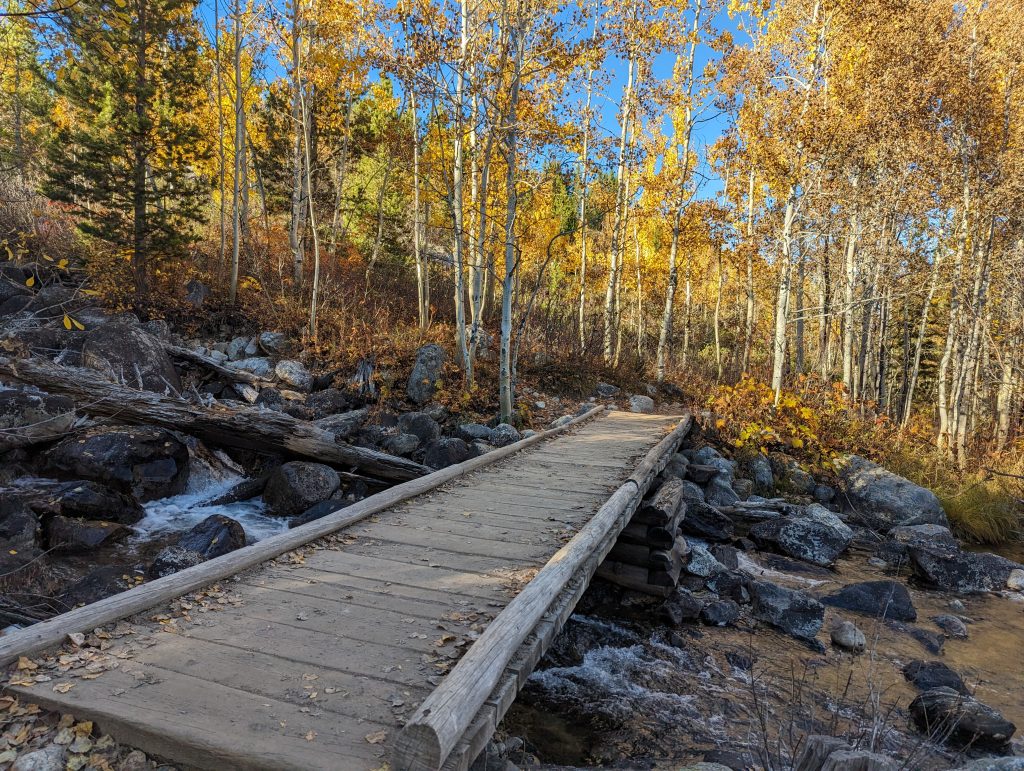
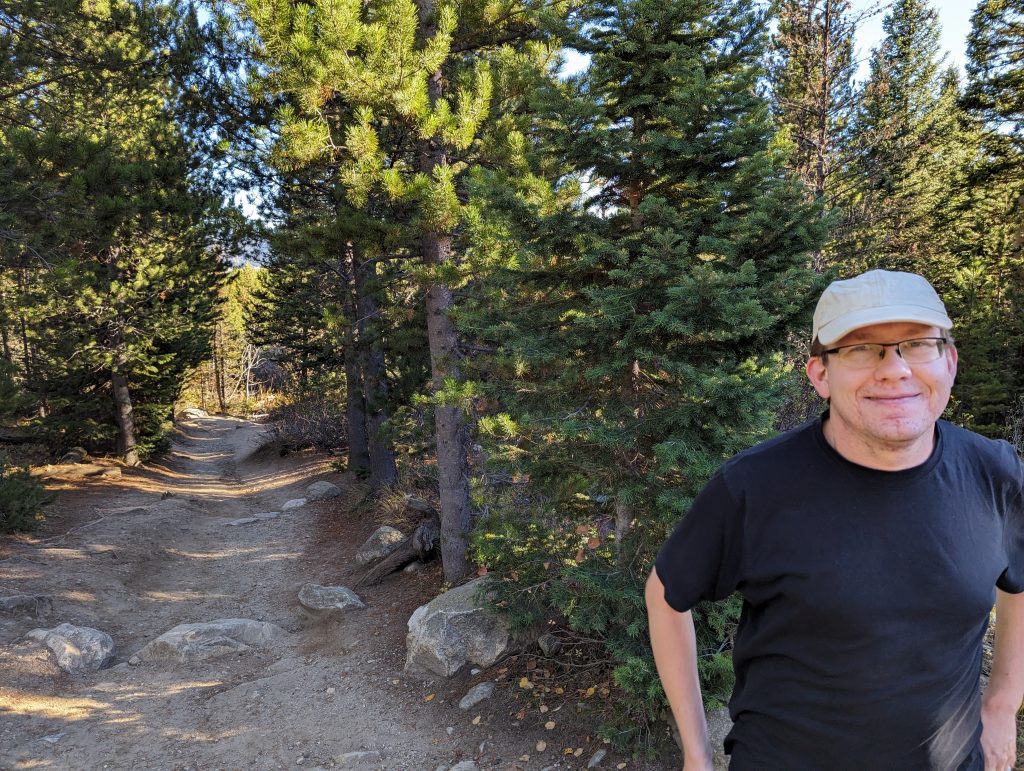
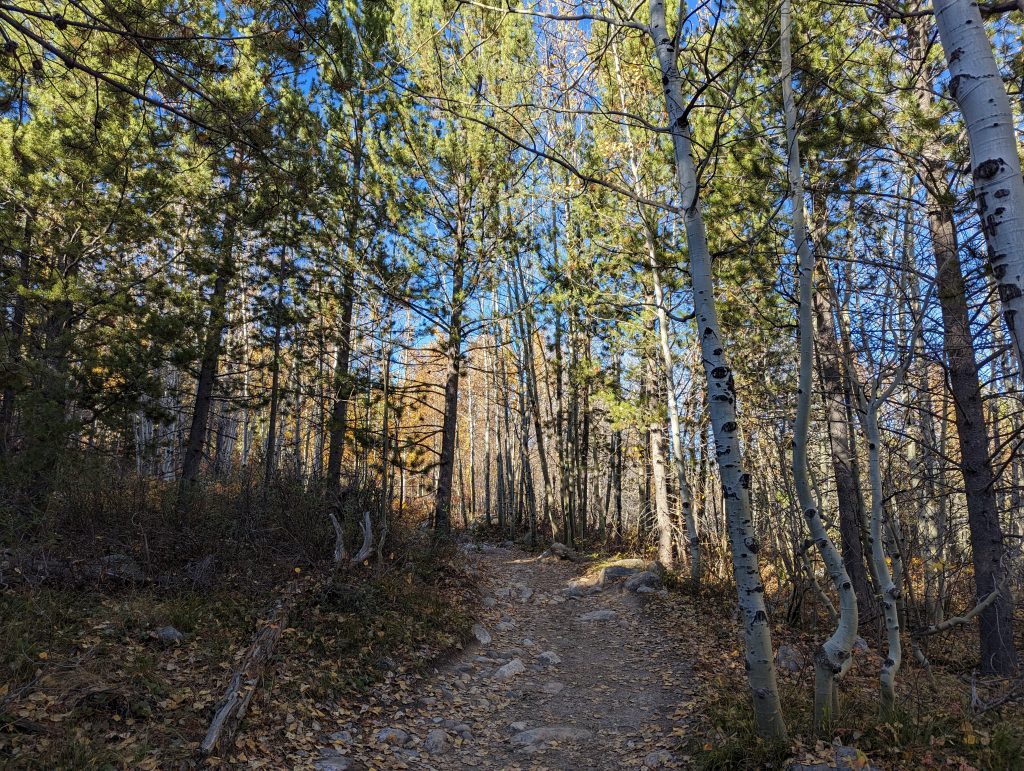
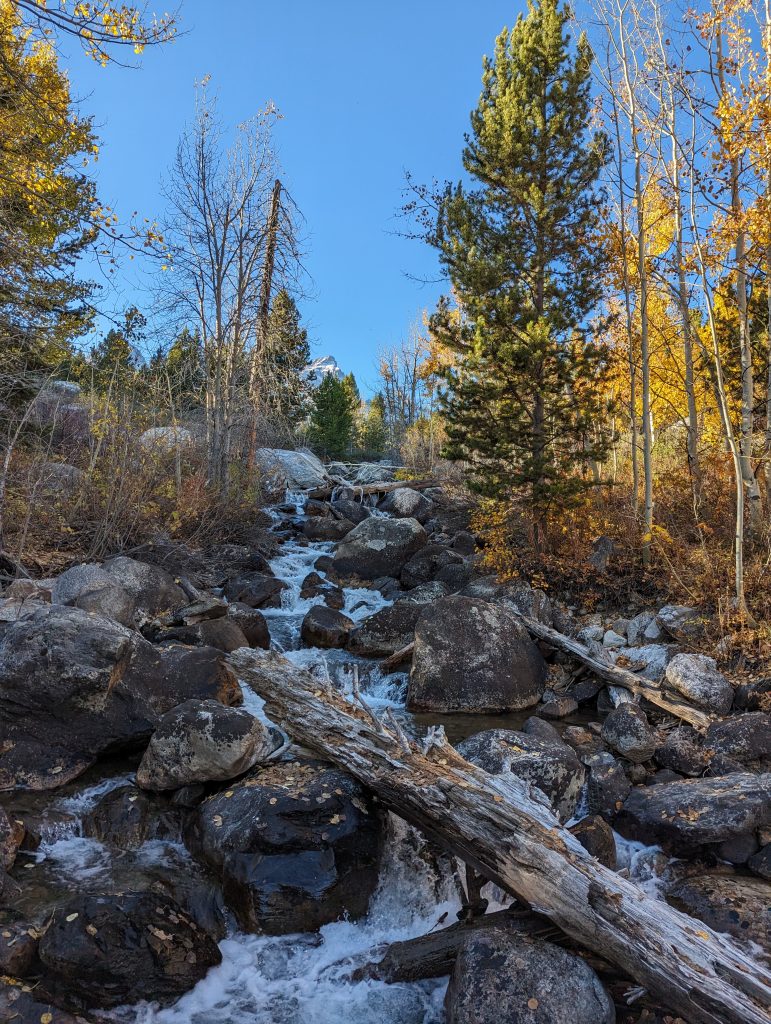
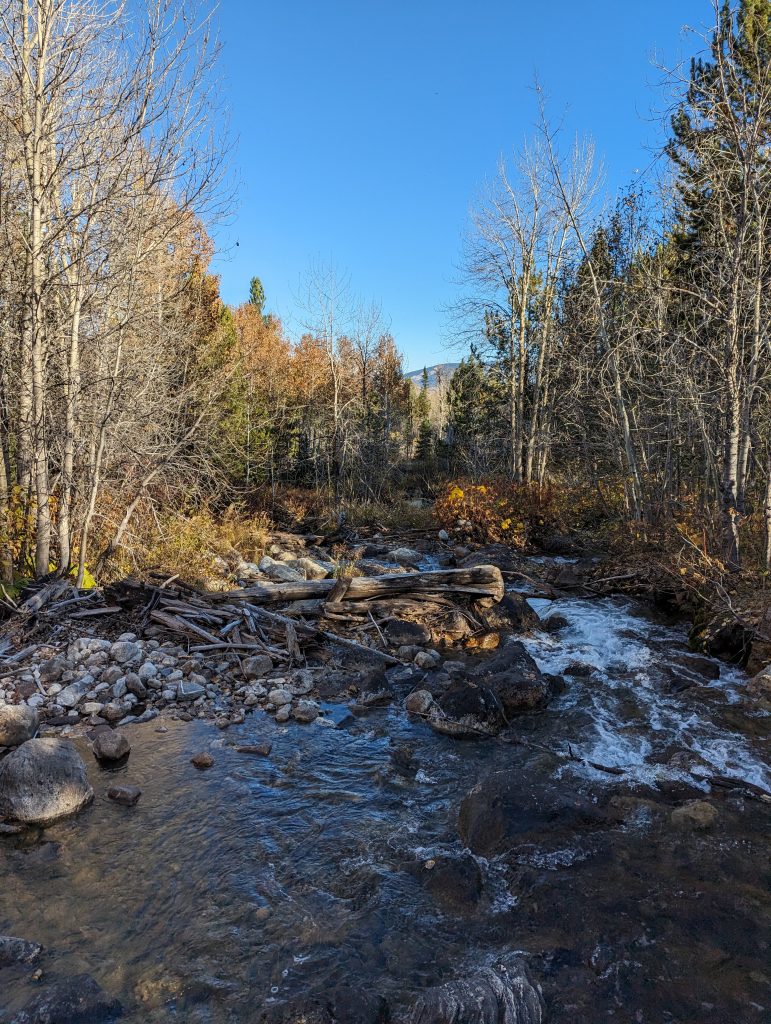
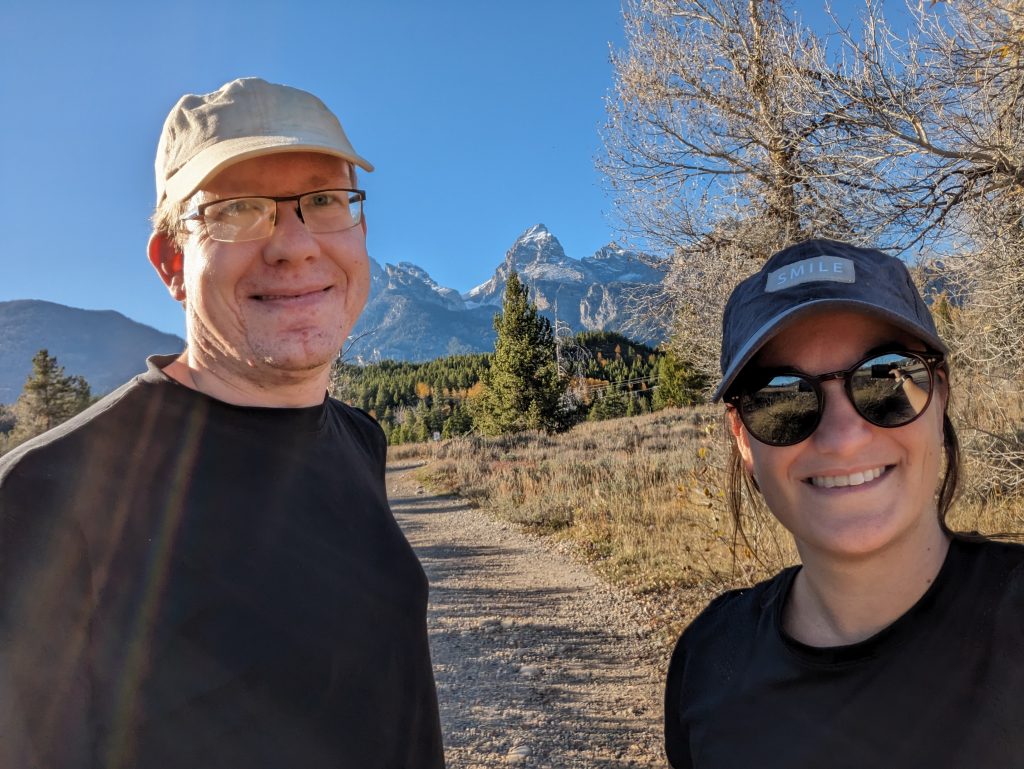
- the whole view is very alpine, sometimes you have the feeling you are in the Alps on the trails.
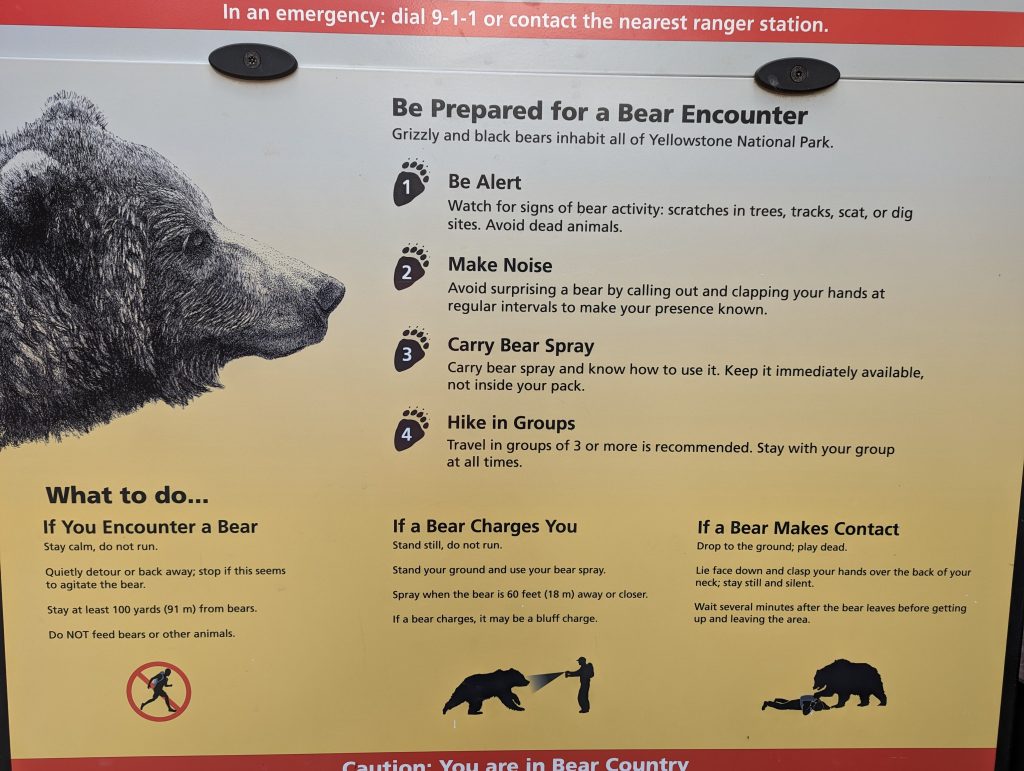
- the only drawback: there are bears in the national park, for which warning signs are put up at every entrance and which always add a small degree of unrelaxedness to the hike.
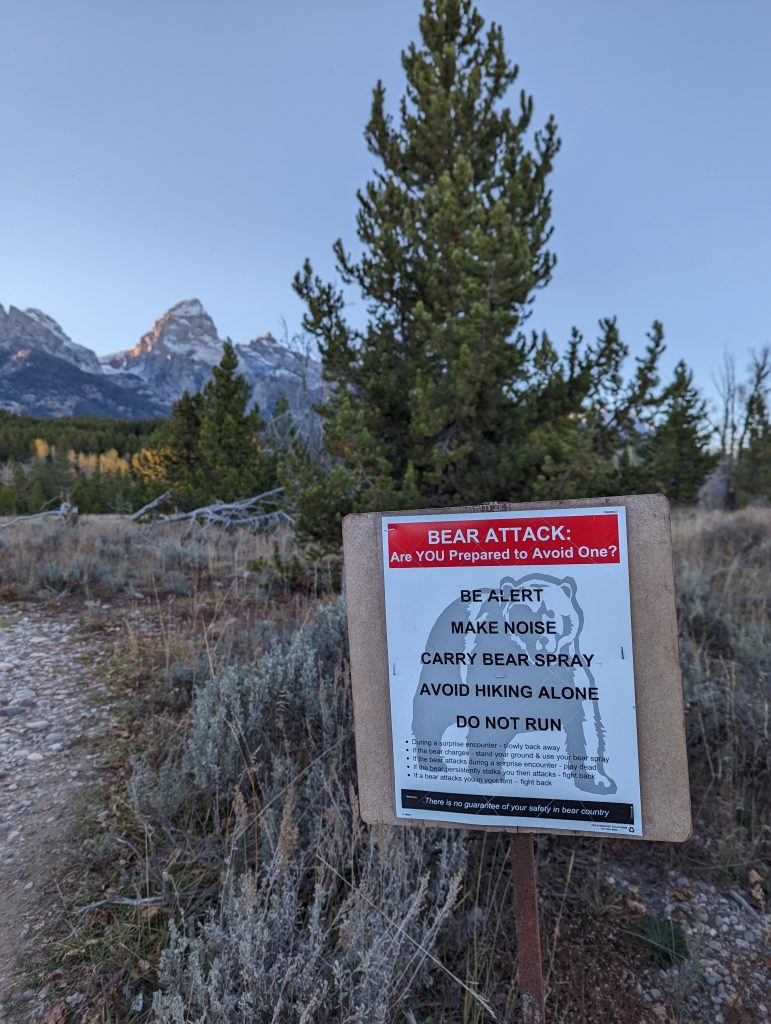
- No problem: I follow the advice of the signs and talk even louder than usual
- Now with the evening atmosphere and the beautiful light of the setting sun, we continue on the Teton Road and then loop back on 89 North, the highway leading back to Jackson.
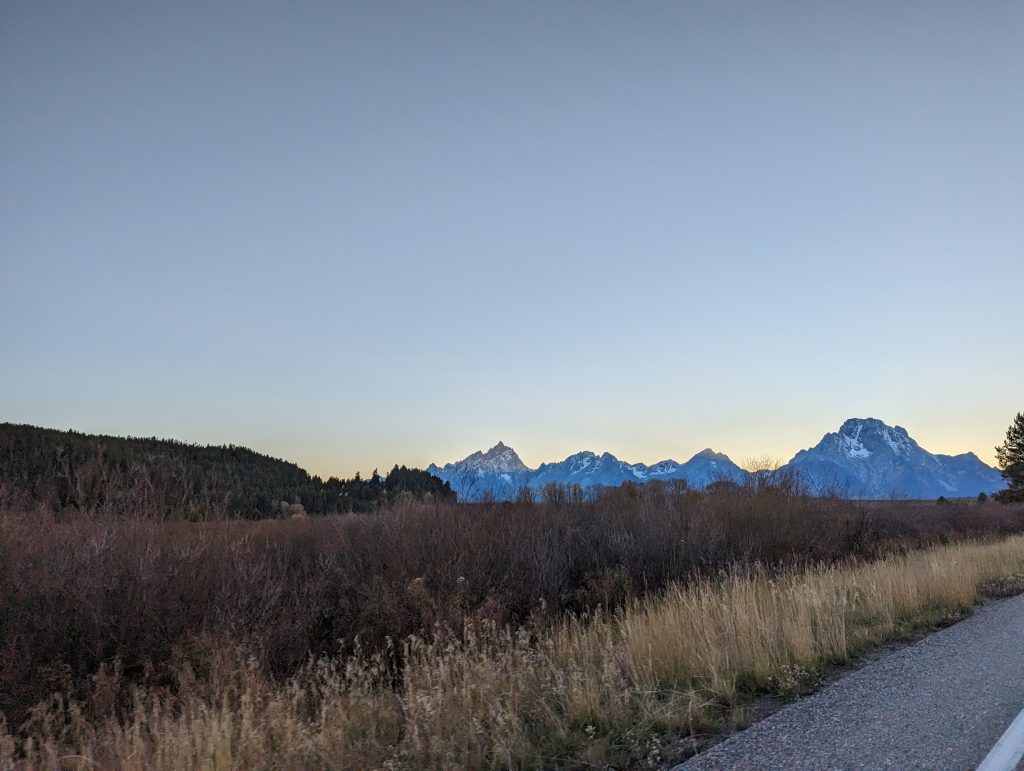
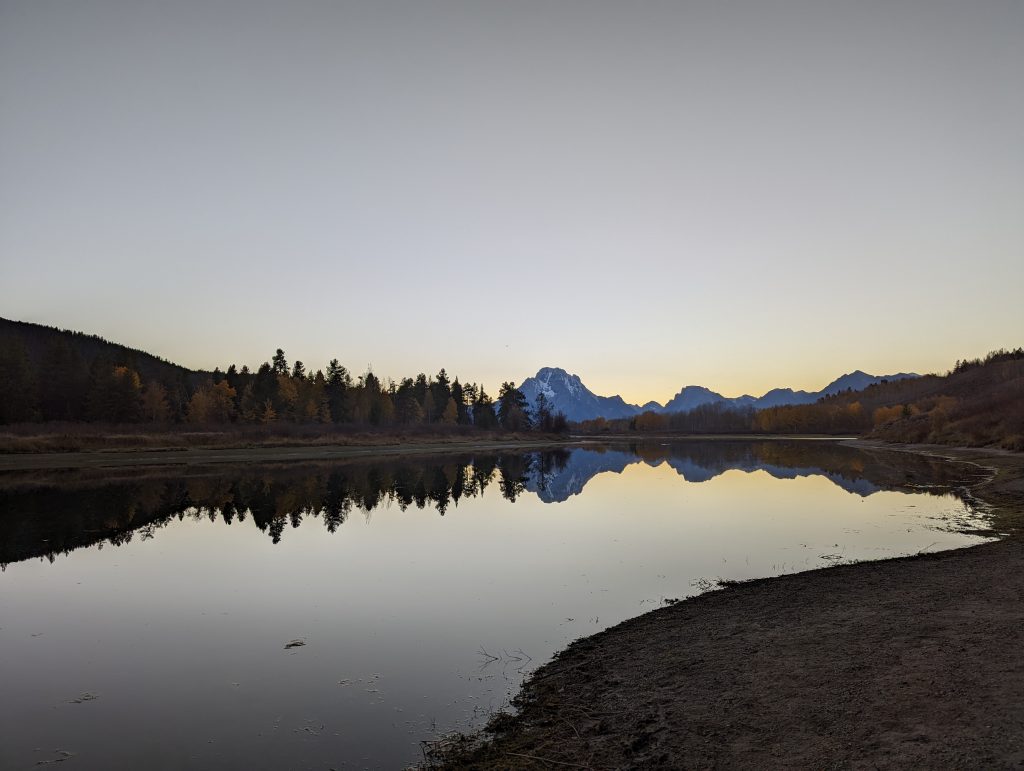
- On the way we stop at Oxbow Bend, where the Snake River makes a bend, at which one can supposedly observe animals coming to the river to drink at dusk.
- this turns out to be a lie: apart from a bird, which I think is a crane (which Matthäus is not convinced of) we don’t see a single animal.
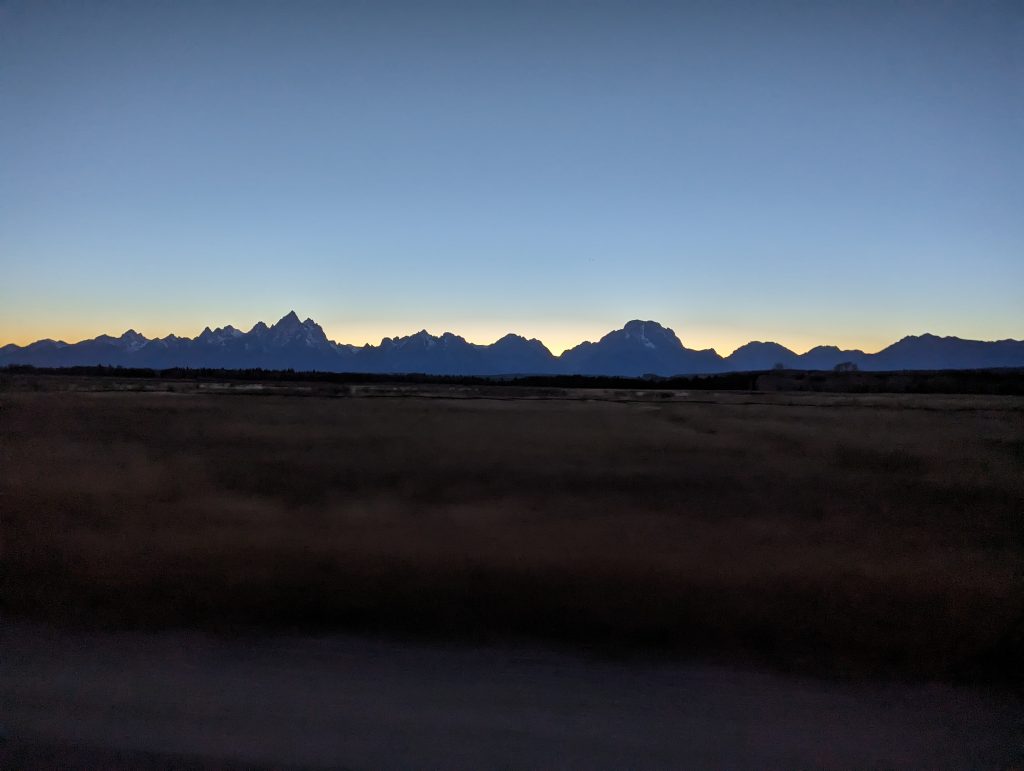
- So we continue back through the park in the dark, where you have to drive very carefully because there is a lot of game, mainly wapiti deer, which like deer like to run in front of the car.
- A sign shows us that one bear, two elk and three wapiti deer (interestingly called “elk” in American English) and four deer have already been hit by cars this month.
- over a pass road we reach the valley where we spend the night
- the people here are known to not be the biggest fans of curves, or are irrationally afraid of them when driving and always brake very cautiously, so driving the pass road is only half as much fun
- we reach our accommodation, the Teton Valley Resort, at 20:45h – and learn from the very nice receptionists that the hot tub is still open until 21h
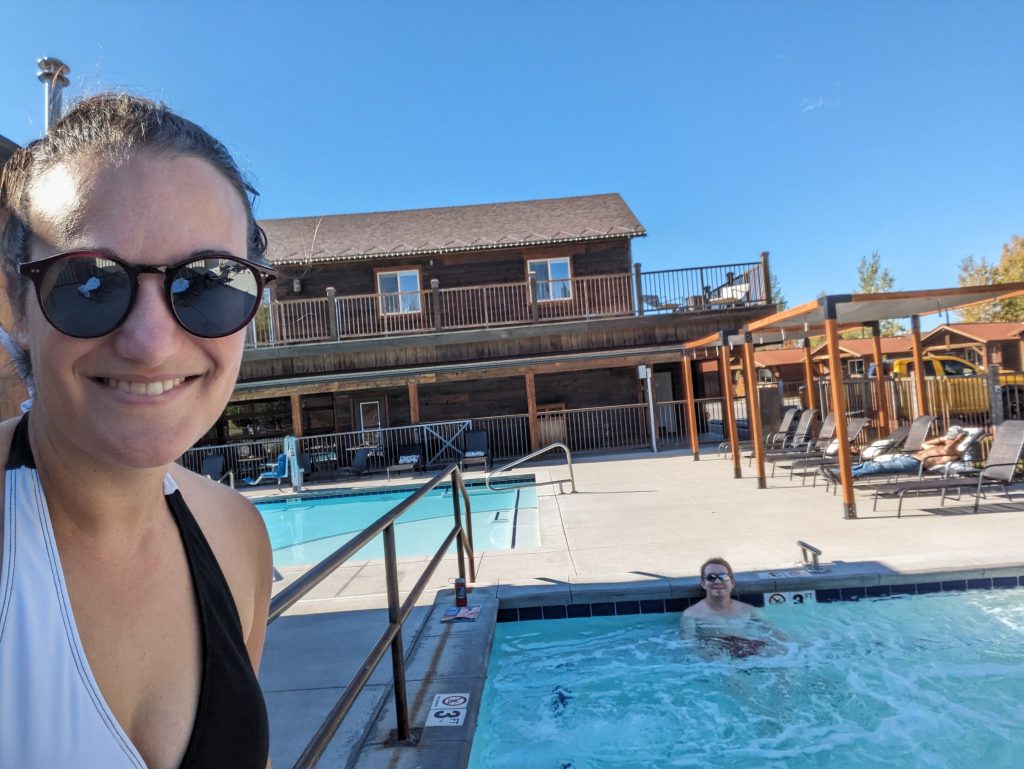
- so we positively throw our stuff into the hut, put on our bathing clothes and jump into the hot tub, which is very cosy and warm and even has a whirlpool function.
- Surprisingly, we have it all to ourselves and it is really great under the beautiful starry sky.
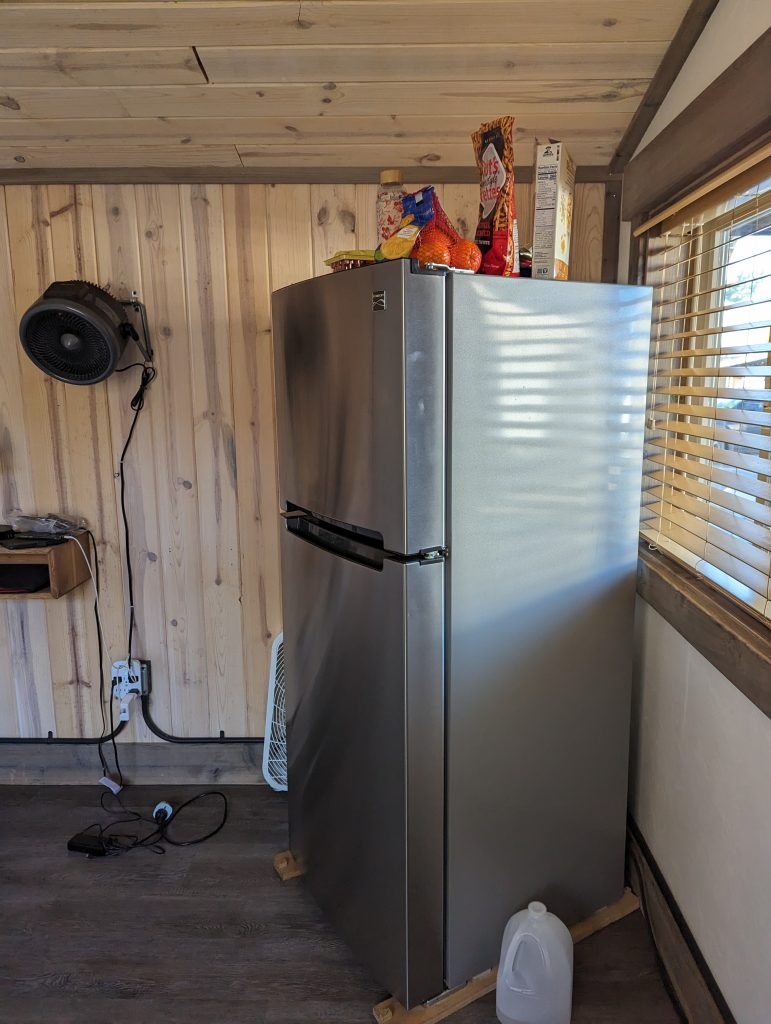
- Nice and warm, we sit down with our dinner in front of our Dry Cabin, a small, very cosy and rustic hut (without water but with a huge fridge), to admire more starry skies, which can be seen very well here again, thanks to low light pollution.
Monday, 9.10.
Chill out day
- We decided that after all the action of the last few weeks, we also needed a day of relaxation, which we used for skyping with family, a talking hands session and soaking in the hot tub.
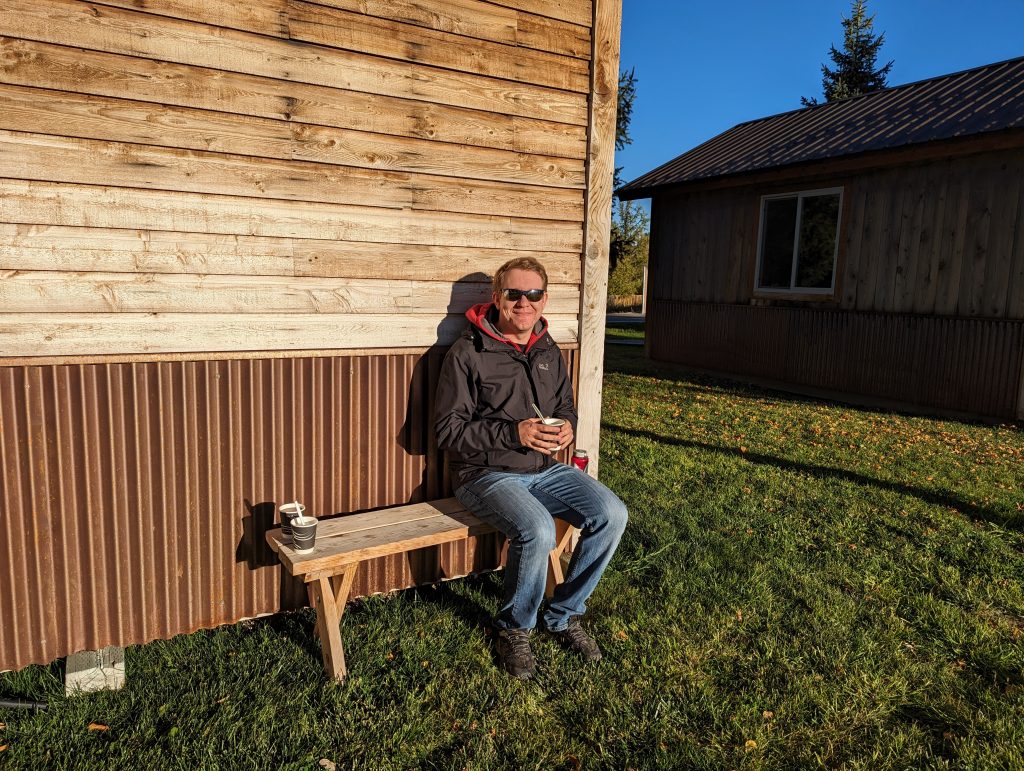
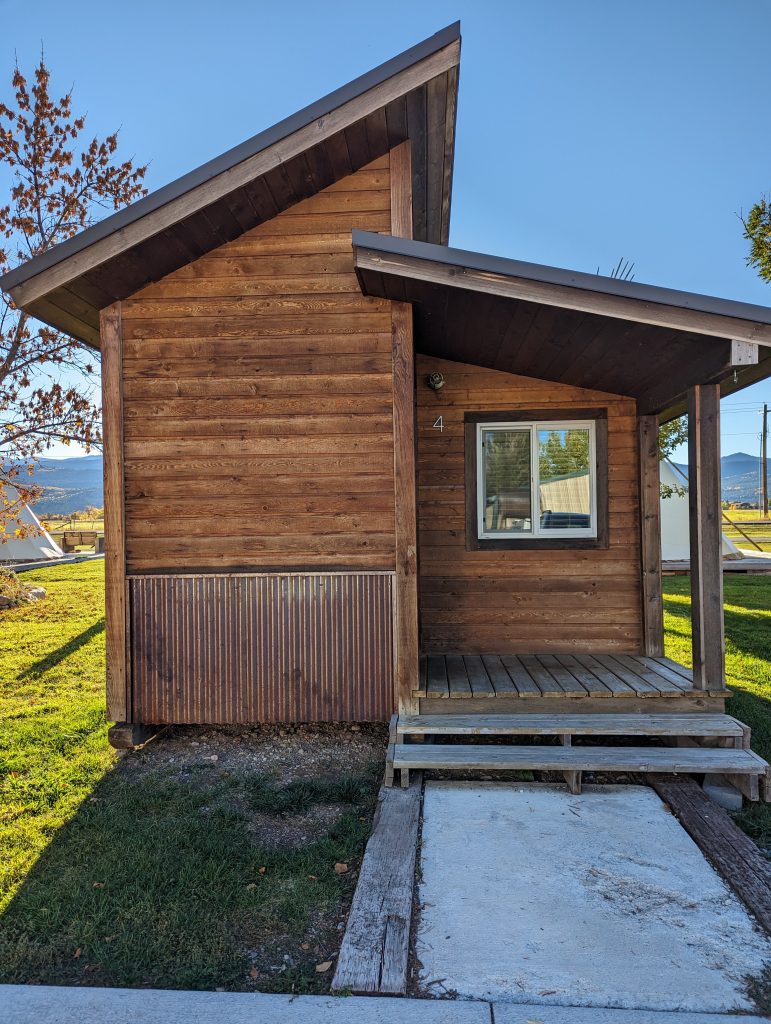
- We also take care of a few organisational things and plan the rest of our trip a bit, including our stay at the Orlanda Universal Parks.
- Their pricing and especially finding out about prices turns out to be so confusing that our mathematician-genes, longing for order, are very upsat and we decide to create an Excel sheet for comparison: after a short consideration, Matthäus slowly states, shaking his head: “We need a multi-dimensional matrix aka tensor” – Ok, no problem -challenge accepted: soon after all price combinations are entered on the Excel sheet and we have found out the cheapest combination of hotel and park entrance fee.
- By the way, compared to the Orlando resorts, Antelope Canyon Tours are amateurs when it comes to business – in the parks you pay for everything and everyone: Harry Potter World, for example, which I would love to visit, is split over two parks (meaning you need two tickets) and if you want to ride the Hogwarts Express you need an extra ticket (park-to-park), just as you only get Early Access (which means you can get into the parks an hour earlier when it’s not so crowded) if you stay at certain resort hotels – Matthäus is not amused to say the least.
Tuesday, 10.10.
The Hippos of the Yellowstone, Old Faithful and Lone Star
- we get up at 4am and after a coffee (YES!) and some muesli for breakfast, we set off for Yellowstone National Park.
- The road takes us through Grand Teton National Park, but we don’t see much of it, as it is still dark, except for some wapitis hanging around next to the road – a great sight (NOT)
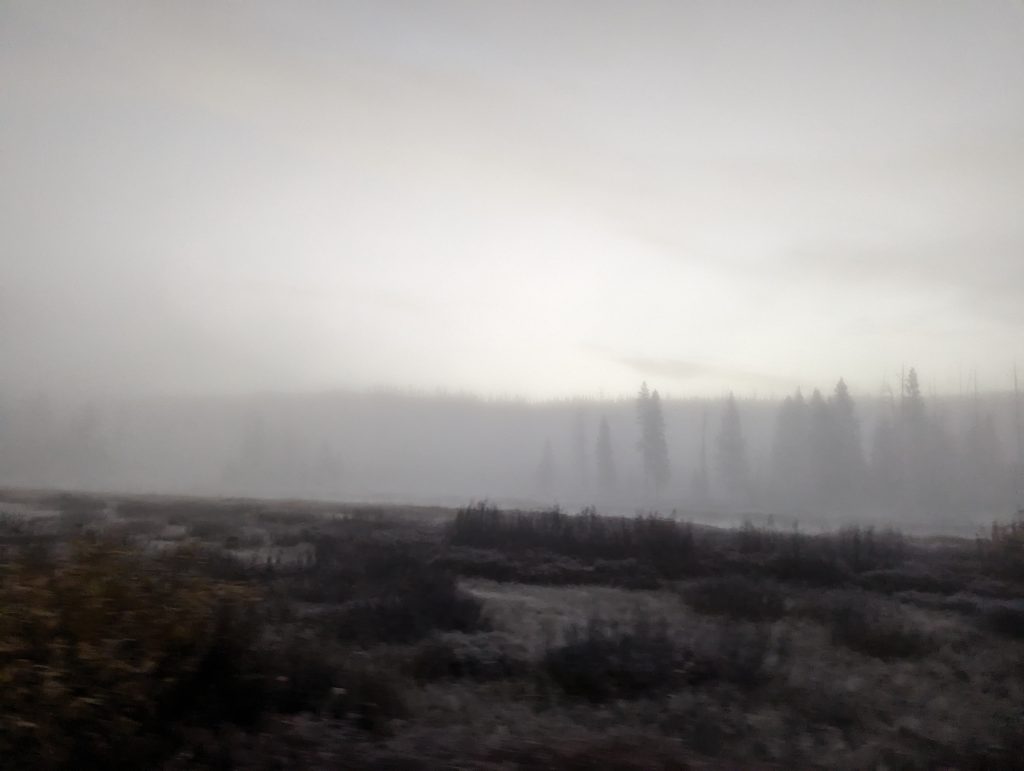
- We pass the entrance to Yellowstone National Park just in time for sunrise.
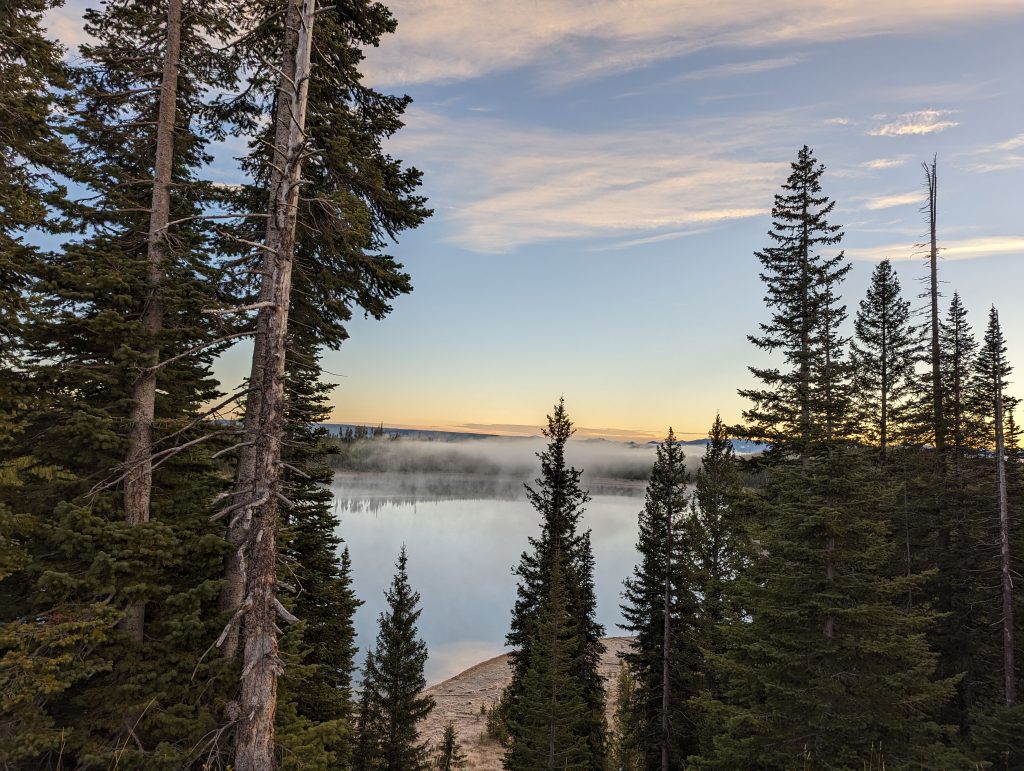
- The sun rises beautifully over Yellowstone Lake, which we drive along for a short while and which looks really impressive.
- The distances here are enormous: without a car you are lost in this national park and even then everything takes time.
- Once again our first stop is the Visitor Centre – this time to check the eruption times of the geysers.
- We read that it opens at 8am, which turns out to be wrong – it opens at 9am.
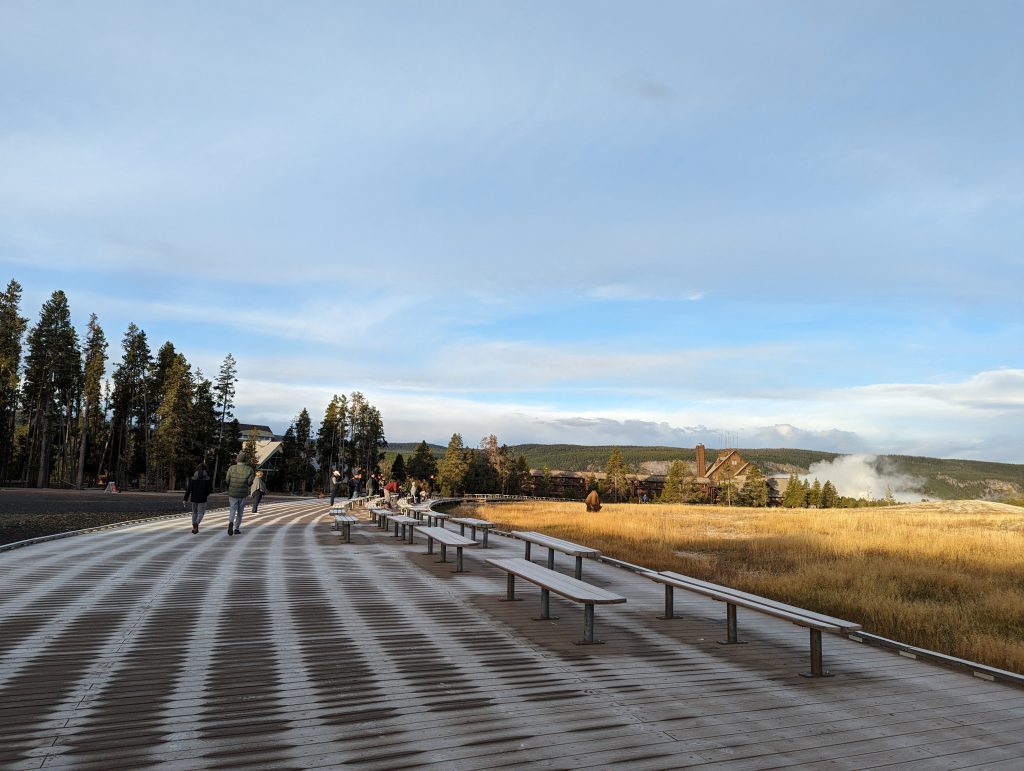
- At first we are not amused, as it is exactly 8am when we arrive, but this quickly subsides as we take a walk around Old Faithful, the large geyser that lies directly in front of the Visitor Centre, and coincidentally it erupts right then
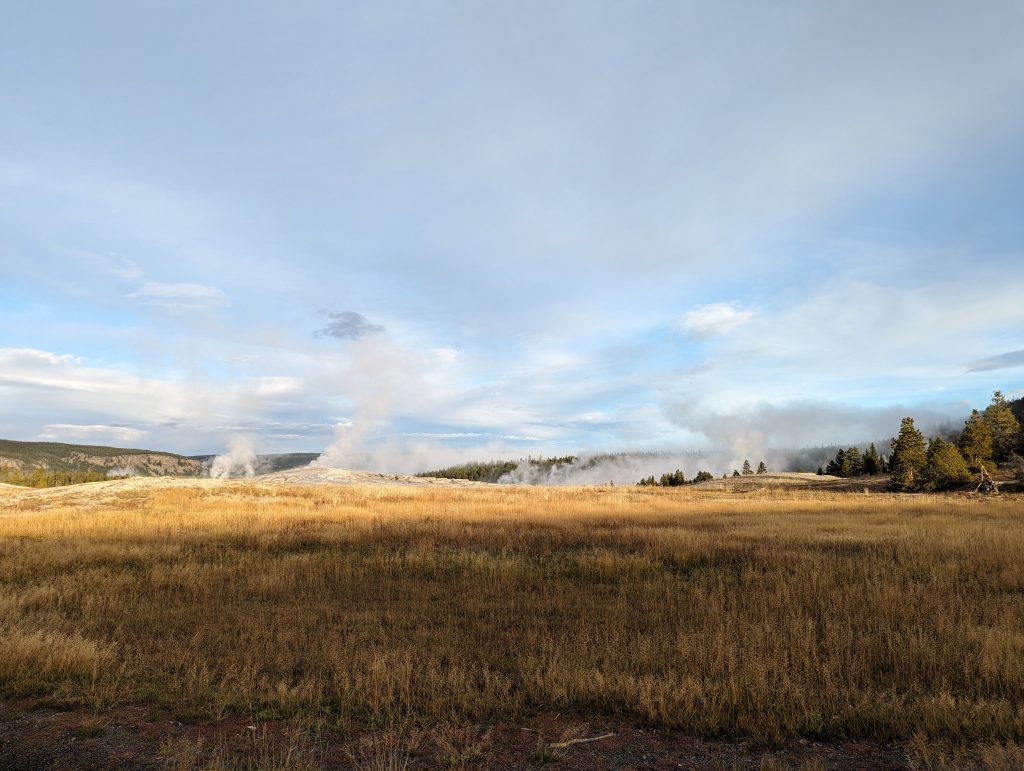
- Wow, that’s timing! It is a spectacle: a huge water fountain erupts from the earth and sprays smoke and water into the air for about 2 minutes – a natural fountain with boiling water, so to speak.
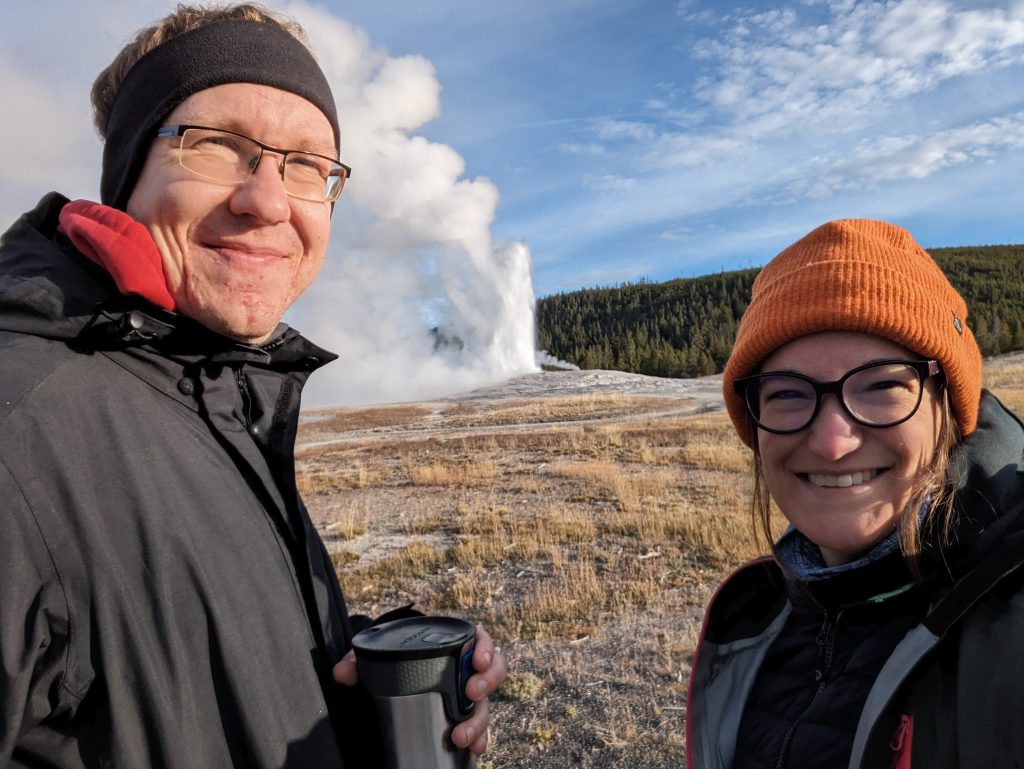
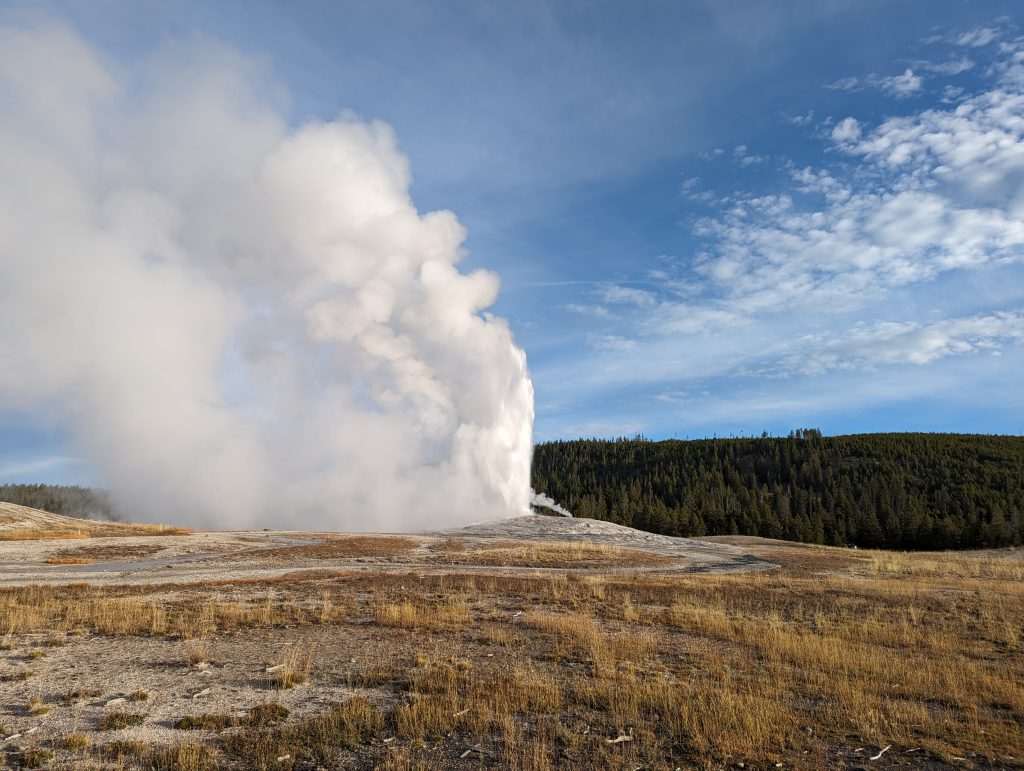
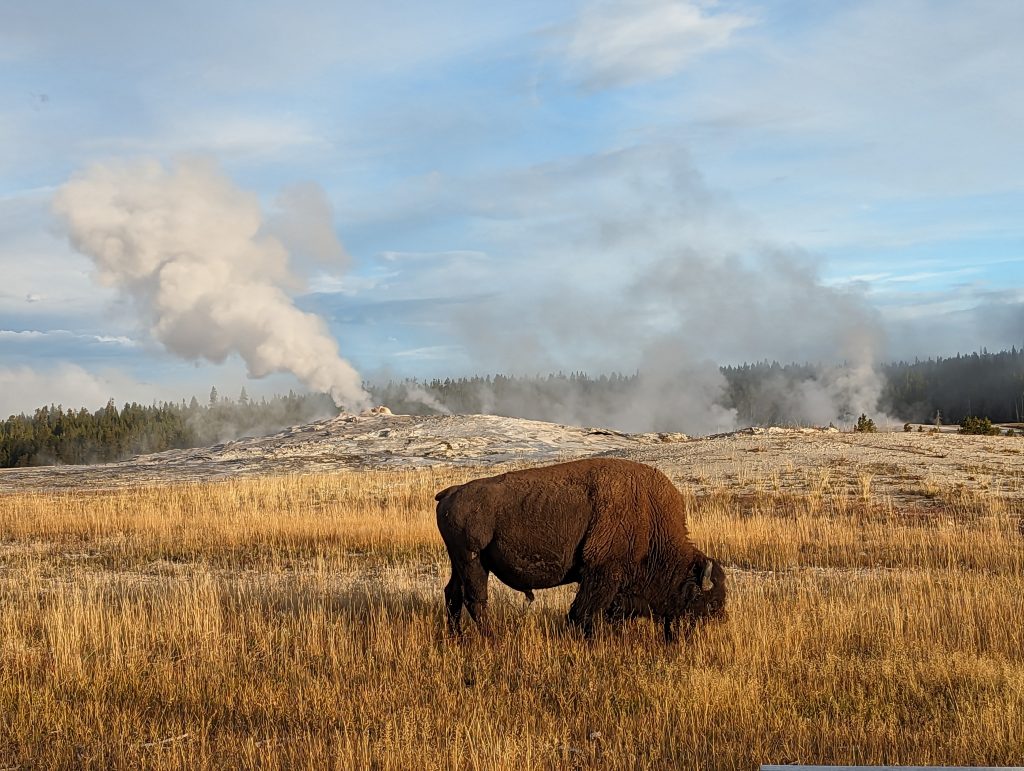
- To complete the picture, there is also a grazing bison hanging around directly in front of the geyser.
- Of course, this attracts a crowd of tourists, all of whom do not keep the 23m distance that should be kept, which in turn attracts a park ranger, who then shouts vehemently: “I need you to step away from that bison!”
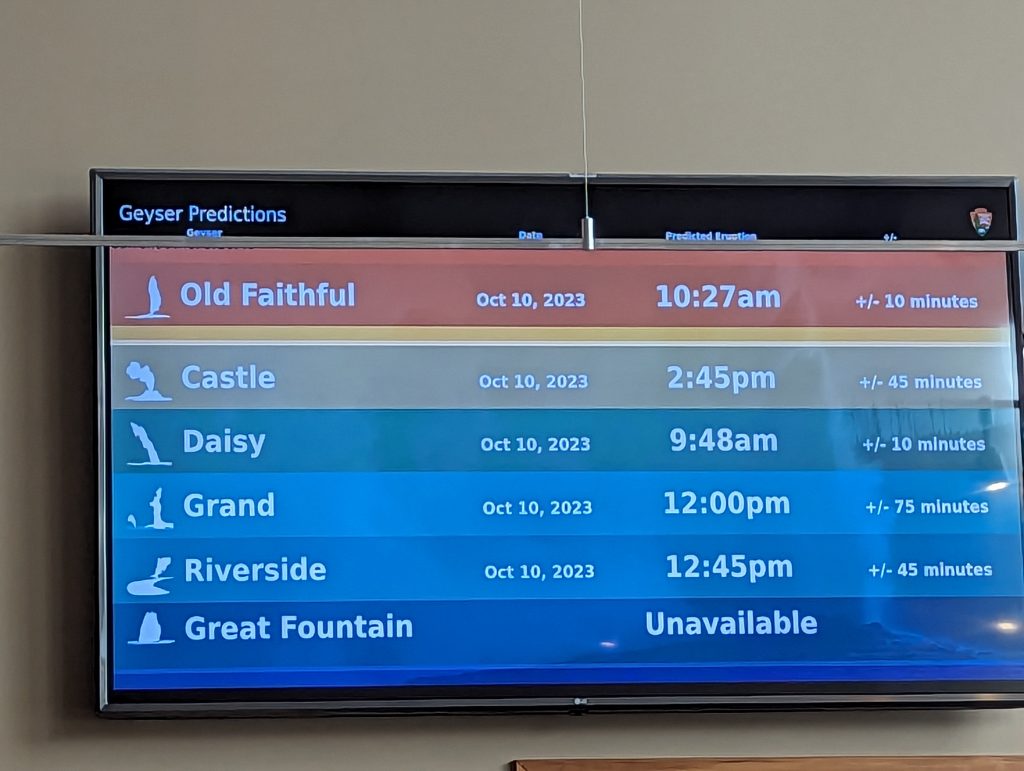
- When the Visitor Centre opens, we look inside to find out the further eruption times and see on the board that the Lone Star, which we want to visit, is not listed at all.
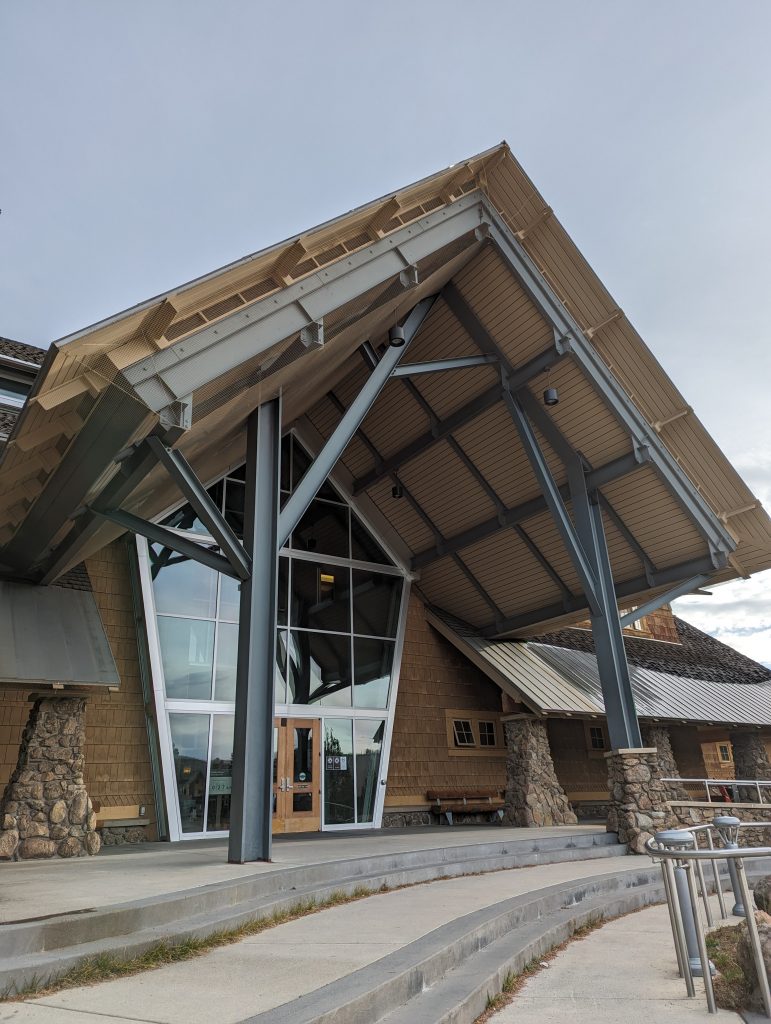
- So I get in the queue to ask about it.
- Matthäus, who is watching the whole procedure, says afterwards that it was a funny contrast, because the group in front of me asked the park ranger what to do in Yellowstone if you have one day to visit it – a very generic question – while I went and asked “What are the expected times of the Lone Star eruptions?” – a very specific question.
- We get an answer, he tells us that the geyser erupts every three hours and that the last reported eruption was yesterday at 11am.
- On the eruption board we see that the Daisy Geyser, which is not far from here, will erupt soon.
- Therefore, we make our way through a landscape teeming with geysers (more than 50% of the total number of geysers in the world are located here) to Daisy Geyser, which we reach just in time for the -again very impressive- eruption.
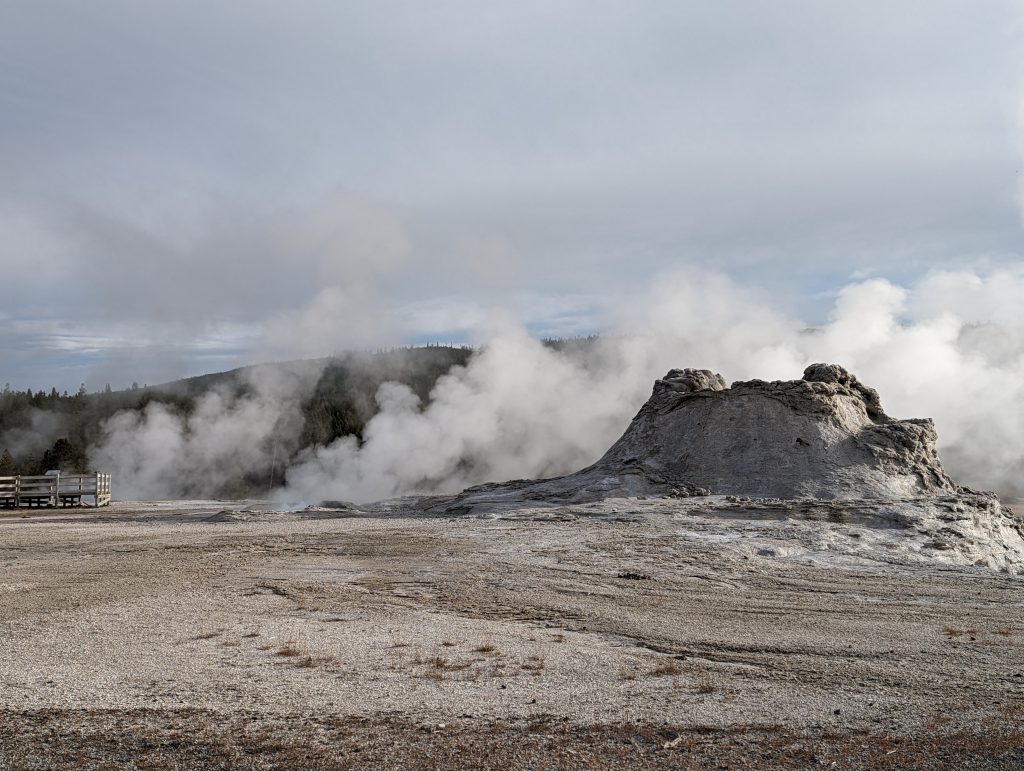
- Back we go past geysers, with such sounding and appropriate names as “Castle Geyser”, which really does look like a castle, and hot springs.
- Afterwards we head straight for the car park “at” Lone Star Geyser, from where there is a 1.75 mile signposted hike to the geyser – and almost run all the way there so that we don’t miss the 11am eruption.
- Once again the walk turns out to be longer than expected and the geyser only appears after about 4km, nevertheless we are there on time at 11h
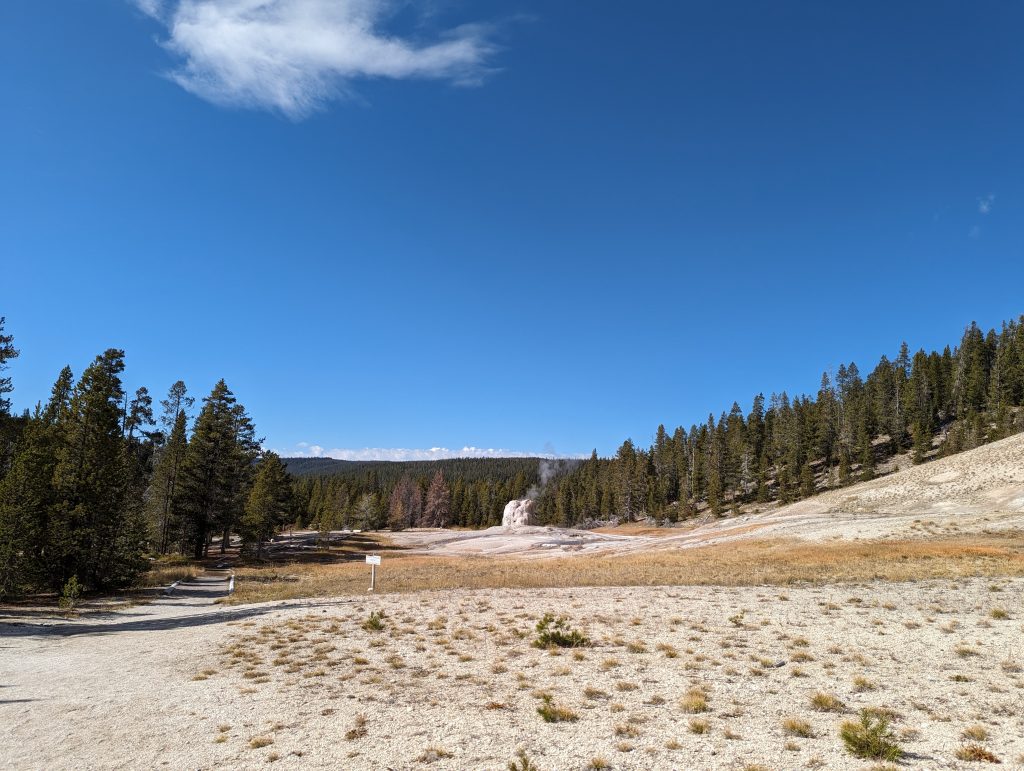
- The geyser lives up to its name, it is completely alone in the middle of a forest clearing.
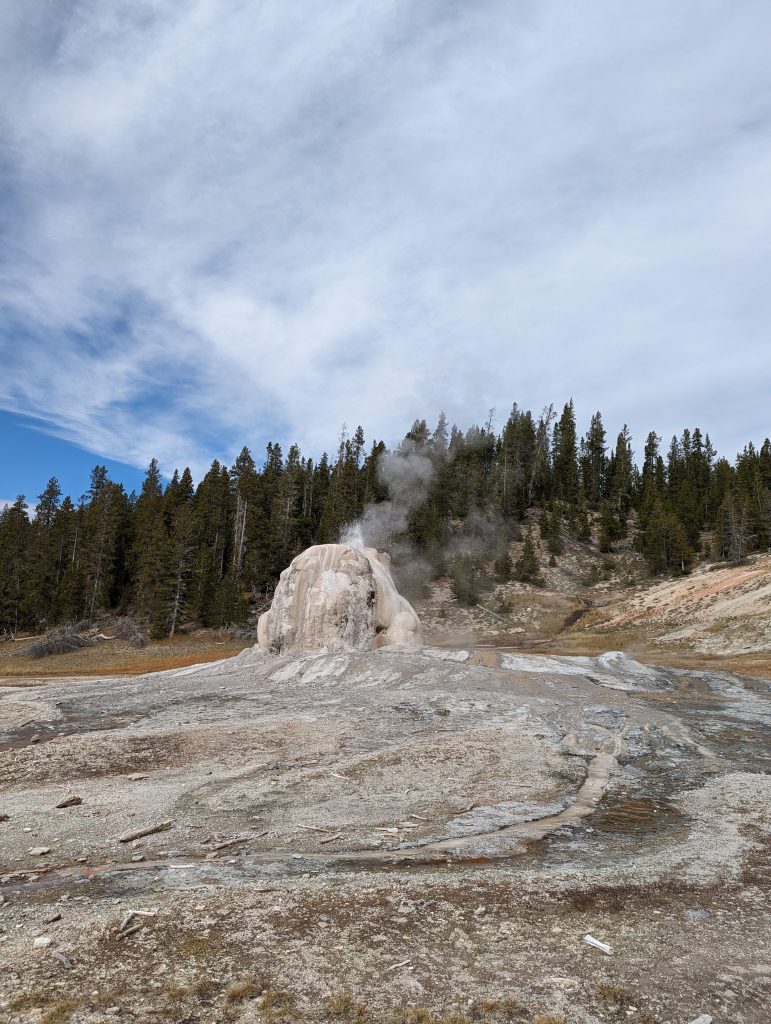
- That doesn’t make it any less impressive – similar to Castle Geyser, a tall tower rises out of the ground and there is no vegetation around the geyser within a few hundred metres, instead small streams lead away where the water from the eruption drains away.
- The geyser eruption starts less spectacularly than the eruptions we have seen so far and than expected: It bubbles away and emits a small water fountain here and there – but most of the time we wait in vain for action.
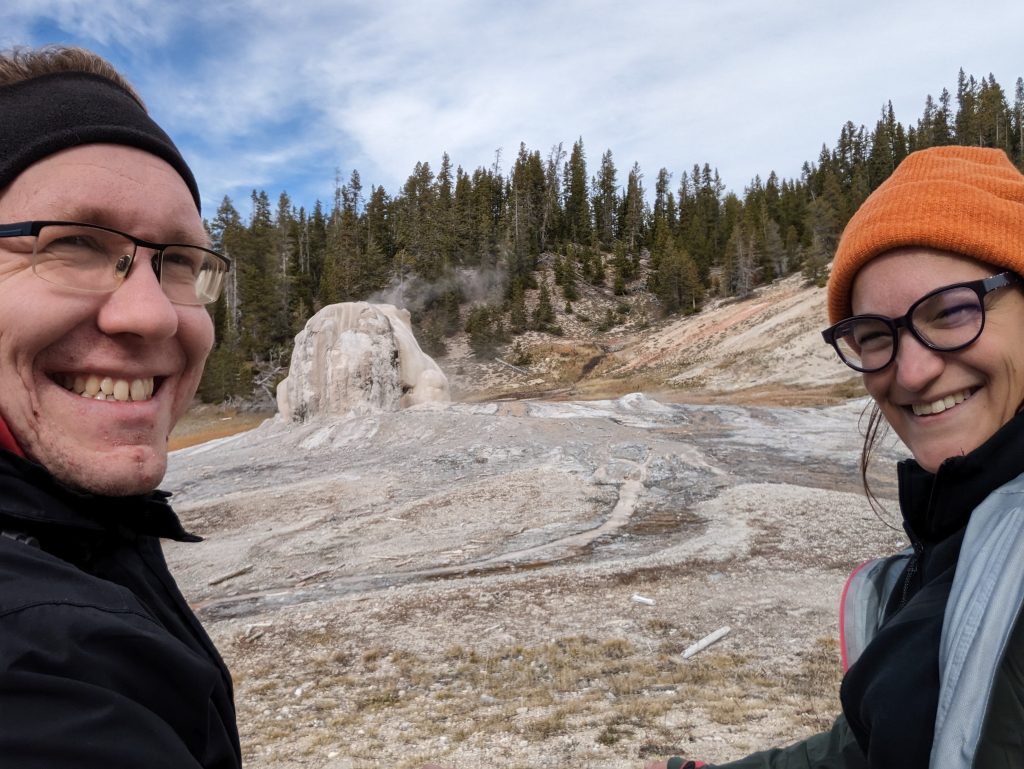
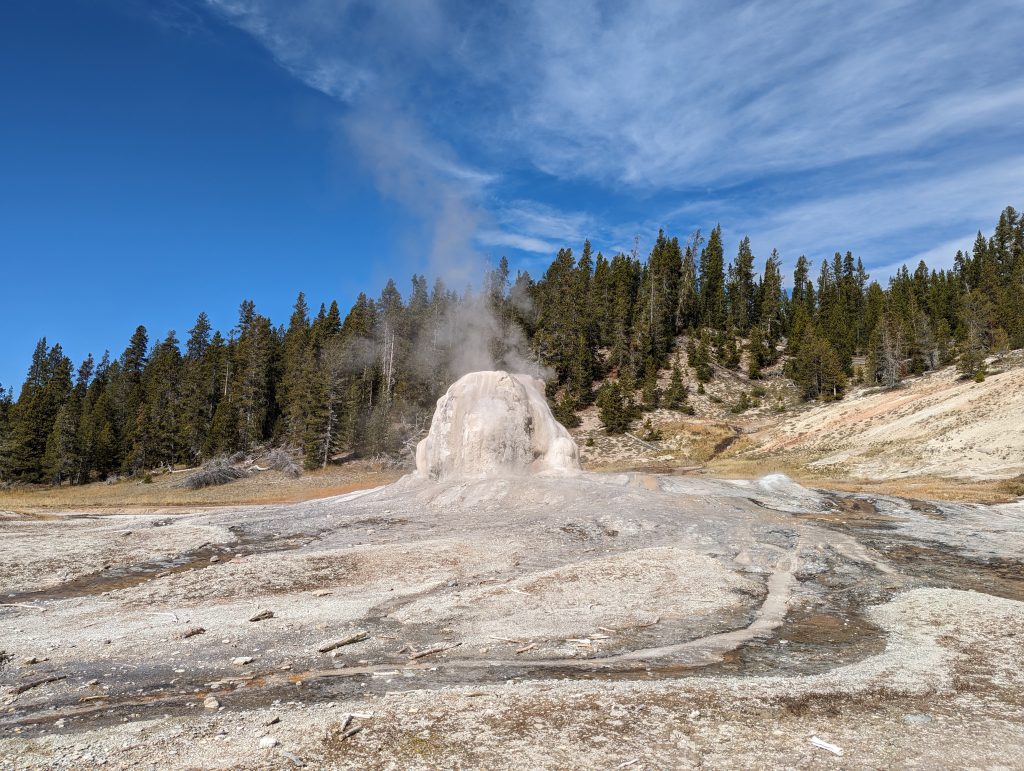
- Before, we read that he breaks out for about 10 minutes to half an hour and now we know how that is meant, it just takes forever to get going
- At 11:30 the spectacle starts and at 12h we think it’s over now as he just smokes.
- There is a logbook where you can enter more detailed data of the eruption and we see that other people have experienced similar eruptions (“minor erruption”).
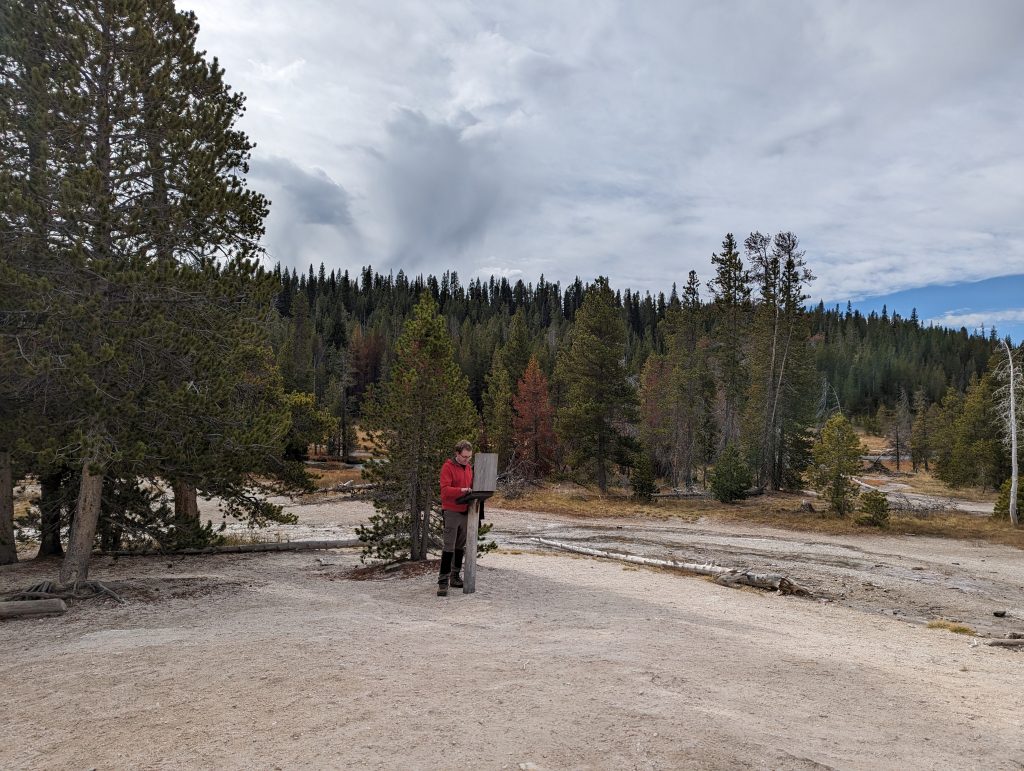
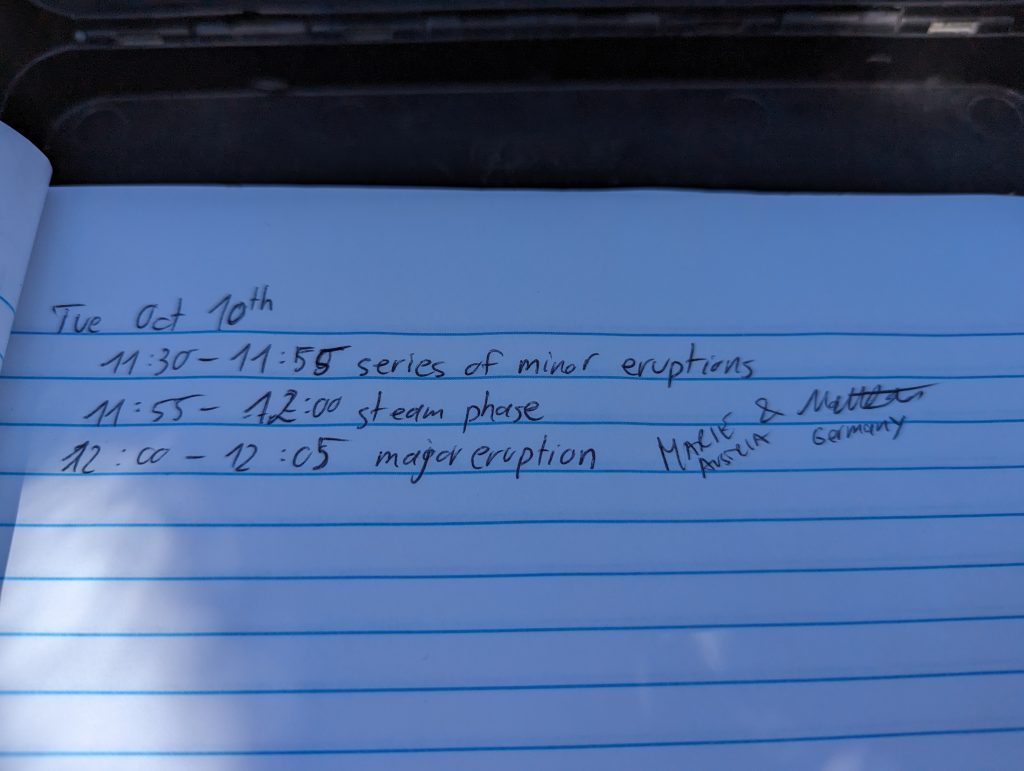
- We record the details concerning the eruption we have witnessed and make our way back to the car.
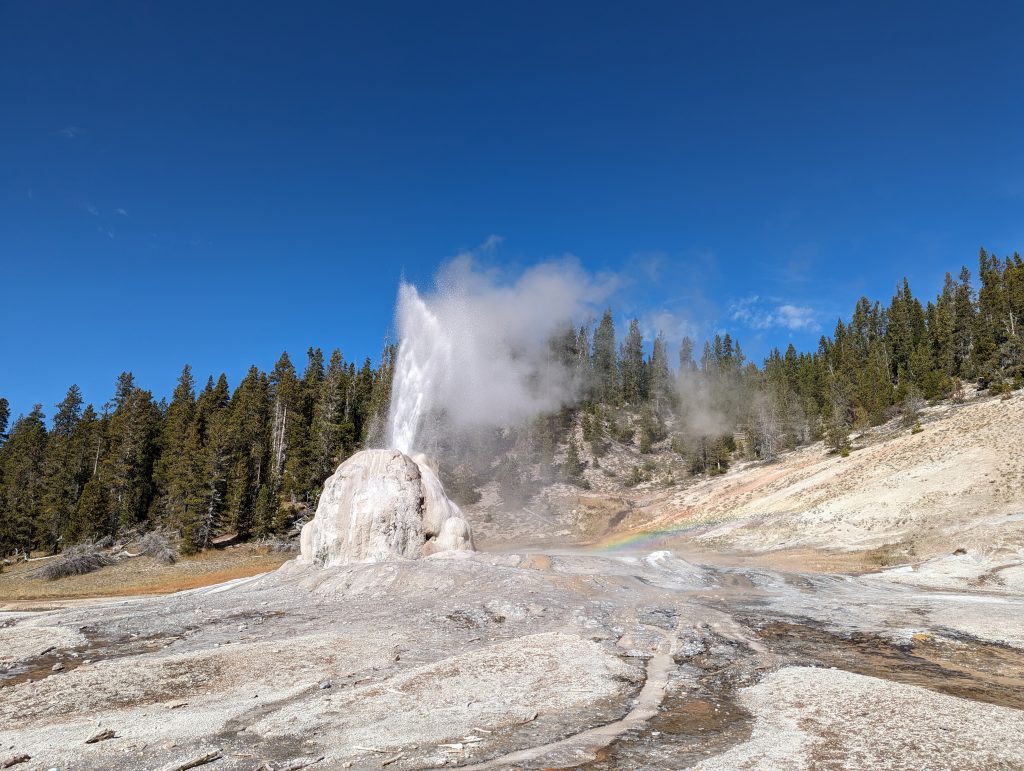
- Just as we turn around to the geyser one last time in the clearing, it suddenly starts shooting a huge fountain of water into the air – Are you kidding me?
- So we quickly run back and experience another “major erruption”, this time a water fountain erupts, just as we had imagined – it is a natural spectacle and we have it all to ourselves – of course there are no other humans (and thank goodness no bears) to be seen.
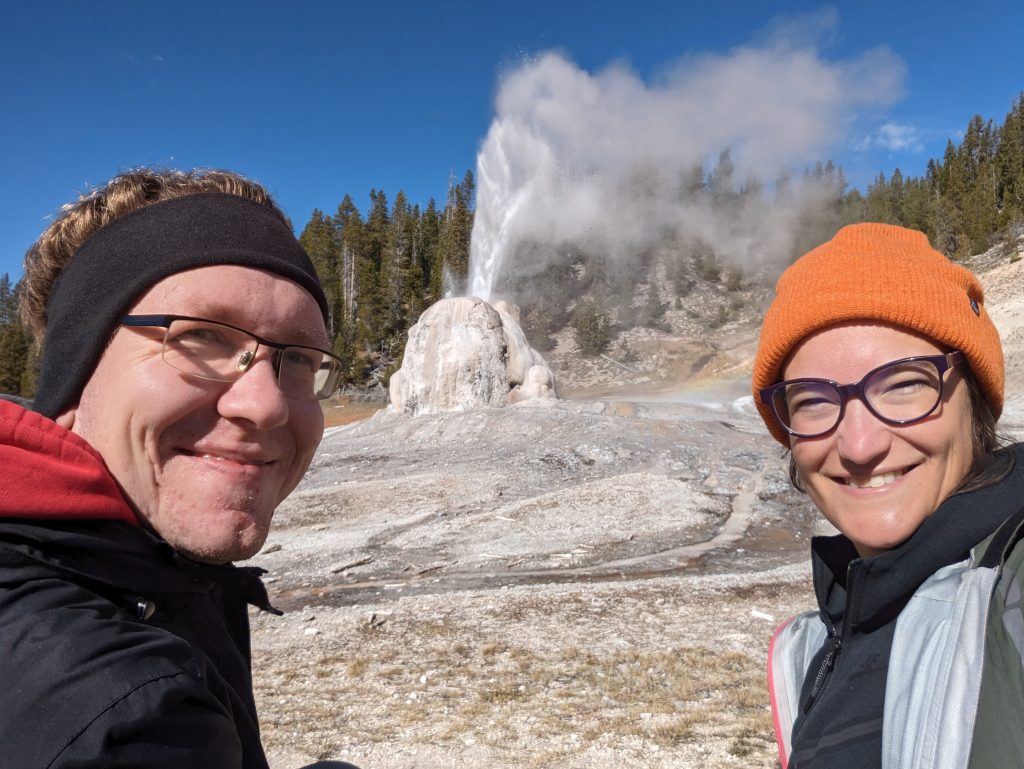
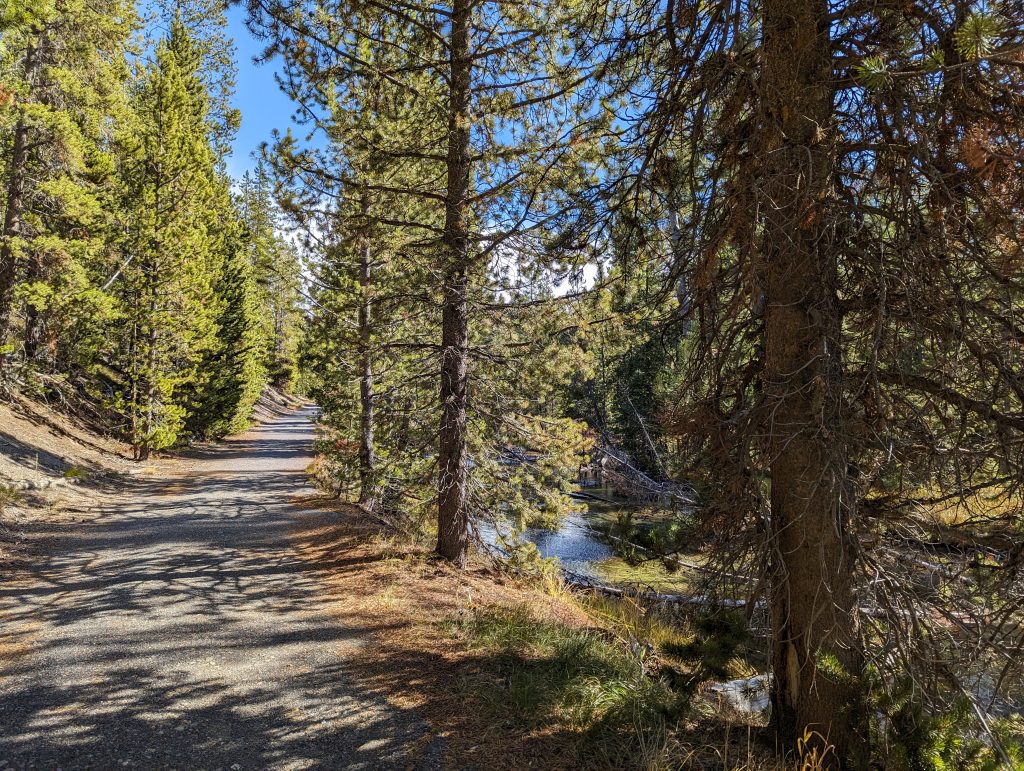
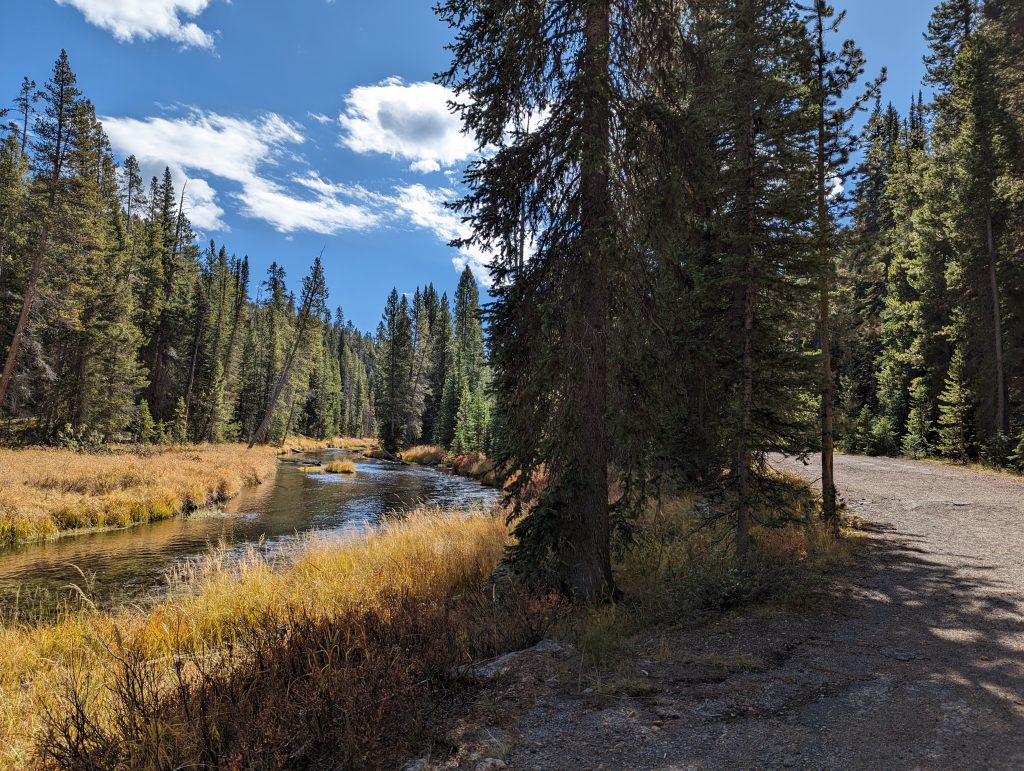
- Satisfied, we take a leisurely walk back and realise that the hike itself is very beautiful.
- The path leads past a river and through a forest and shows us the park again in its magnificent colours, which are particularly bright in the autumn sun shining from the sky.
- We head back to the Visitor Centre, where we get an update on eruption times and learn the difference between geysers, hot springs, mud pots and steam vents:
- First of all, it’s good to know that the entire Yellowstone National Park is a dormant volcano
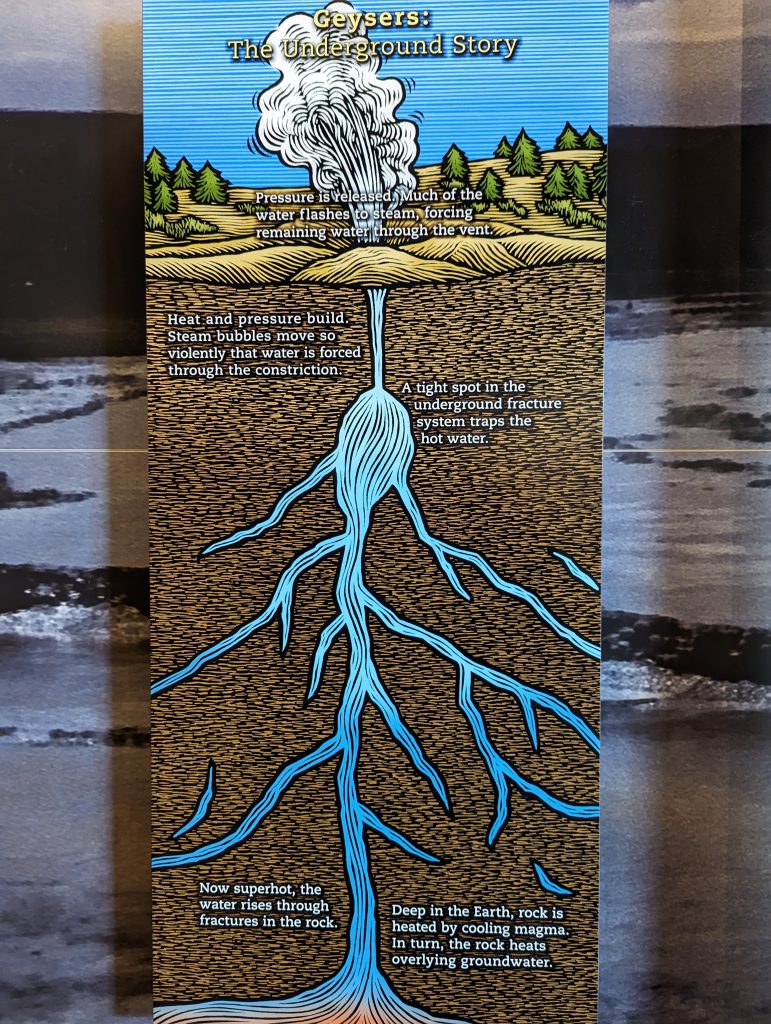
- Geysers are formed when water is heated by hot rock in the ground, forcing its way up through permeable rock layers, only to be stopped before reaching the earth’s surface at an impermeable point, from where it can only reach the earth’s surface through a small gap that functions like a kind of valve, This water then accumulates in an underground basin and becomes mostly steam which passes through the valve and at some point the pressure becomes so great that the water shoots out of the basin through the valve to the surface in the form of a fountain.
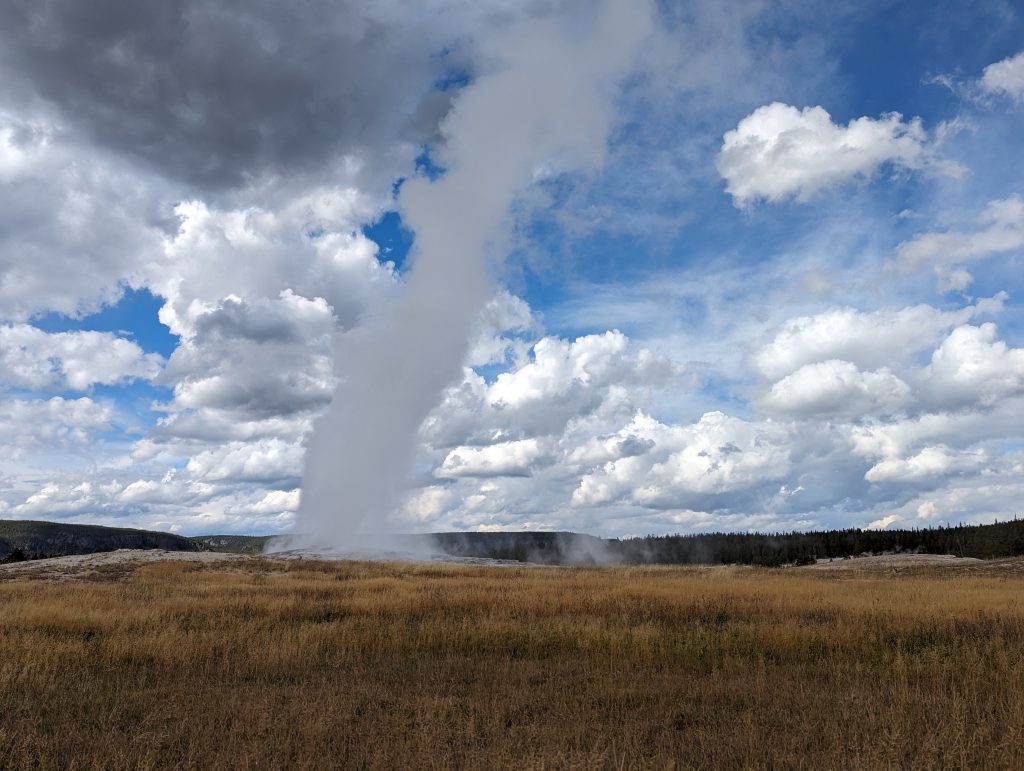
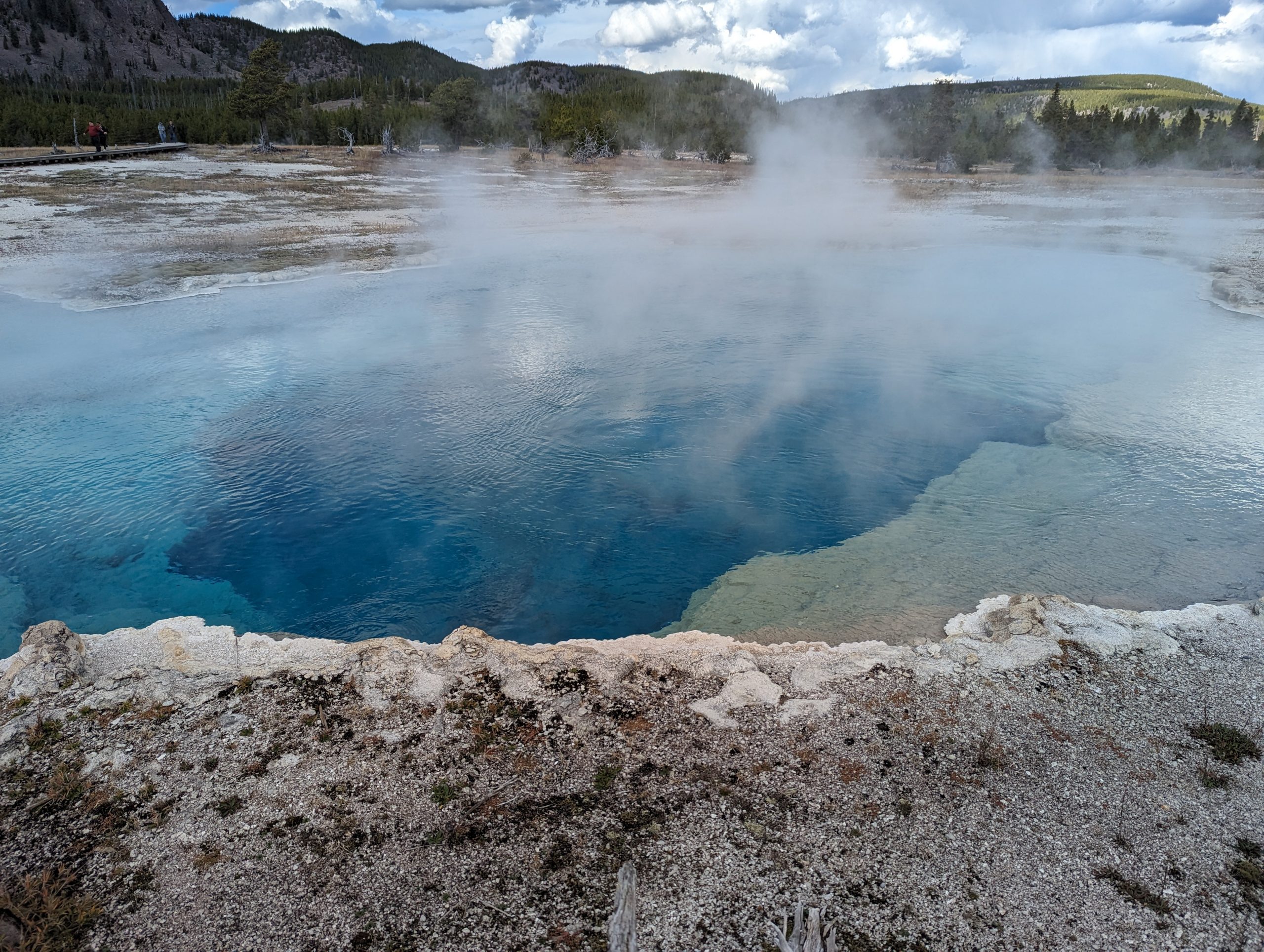
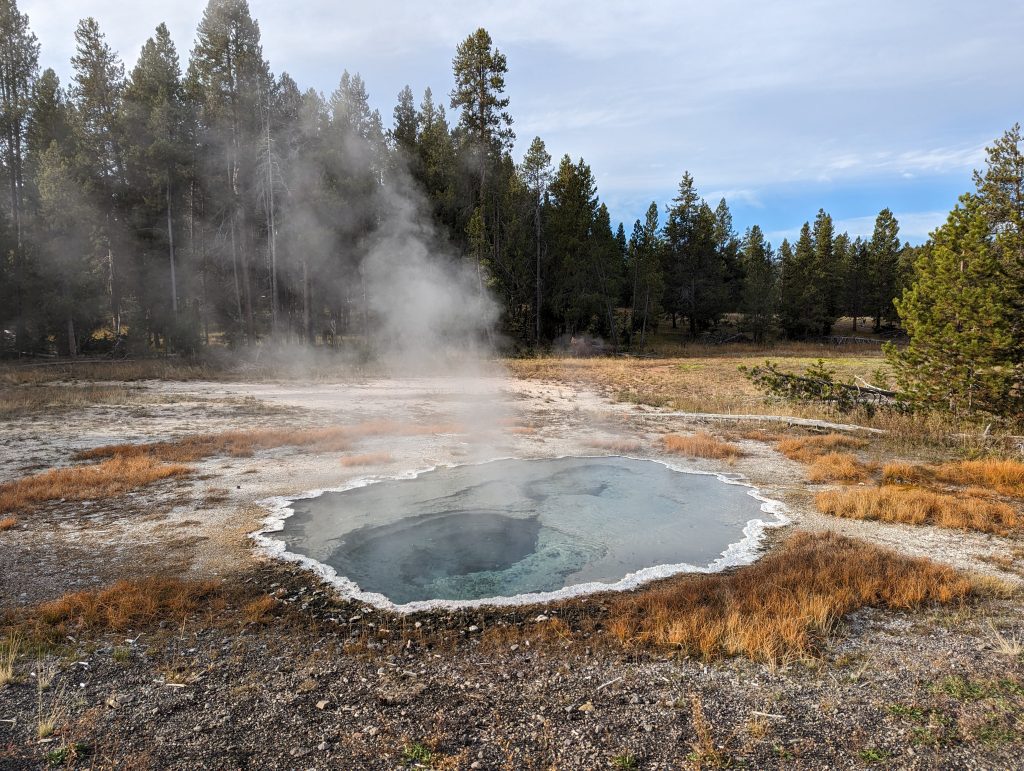
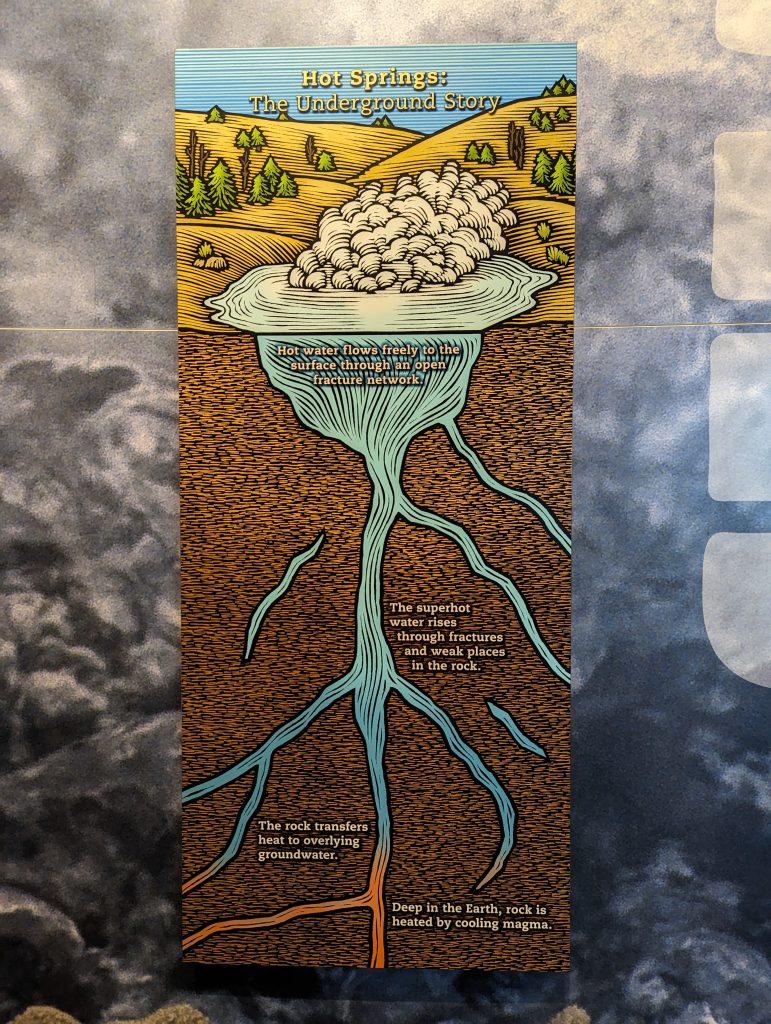
- Hot springs work in the same way, except that there is no valve, but the hot water comes directly to the surface of the earth and can form a pool there
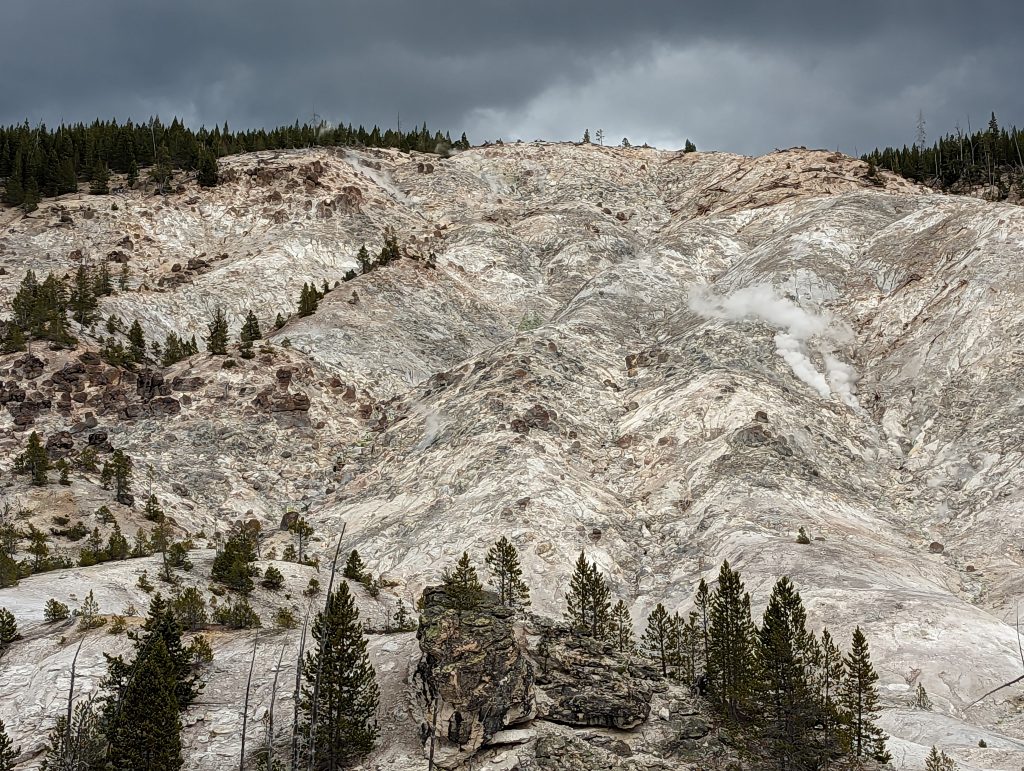
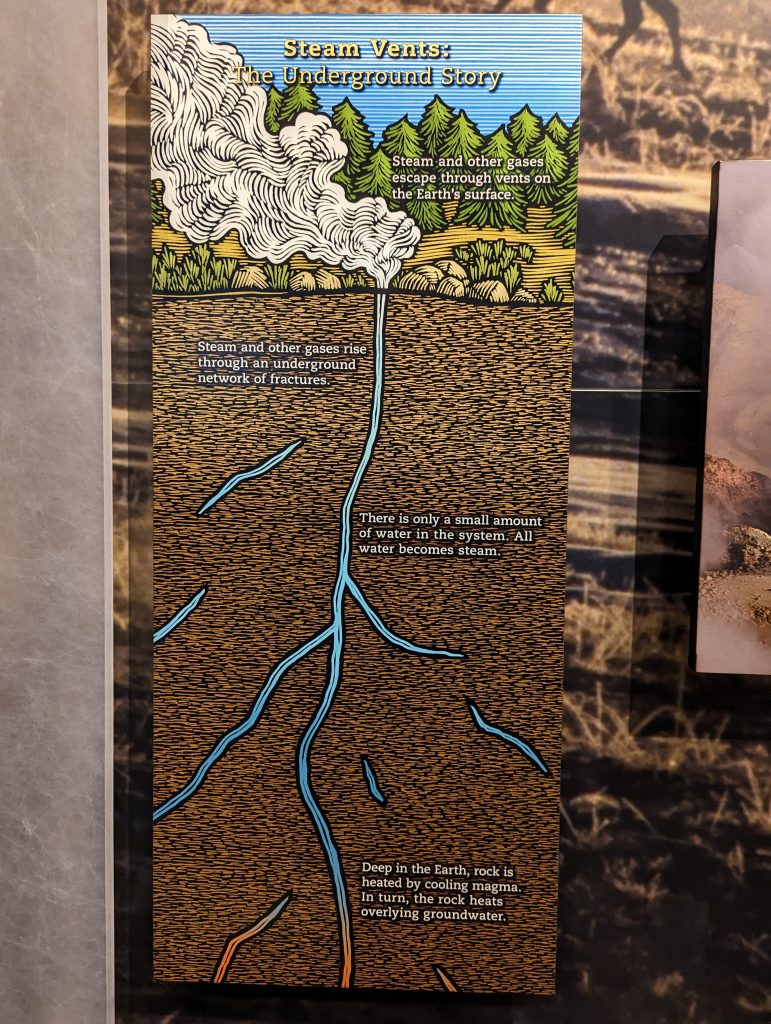
- With steam vents, the water cannot form a pool on the surface of the earth, but instead reaches the surface of the earth through a small gap in the form of steam – this can lead to very loud whistling or similar noises, which can sometimes be heard from far away.
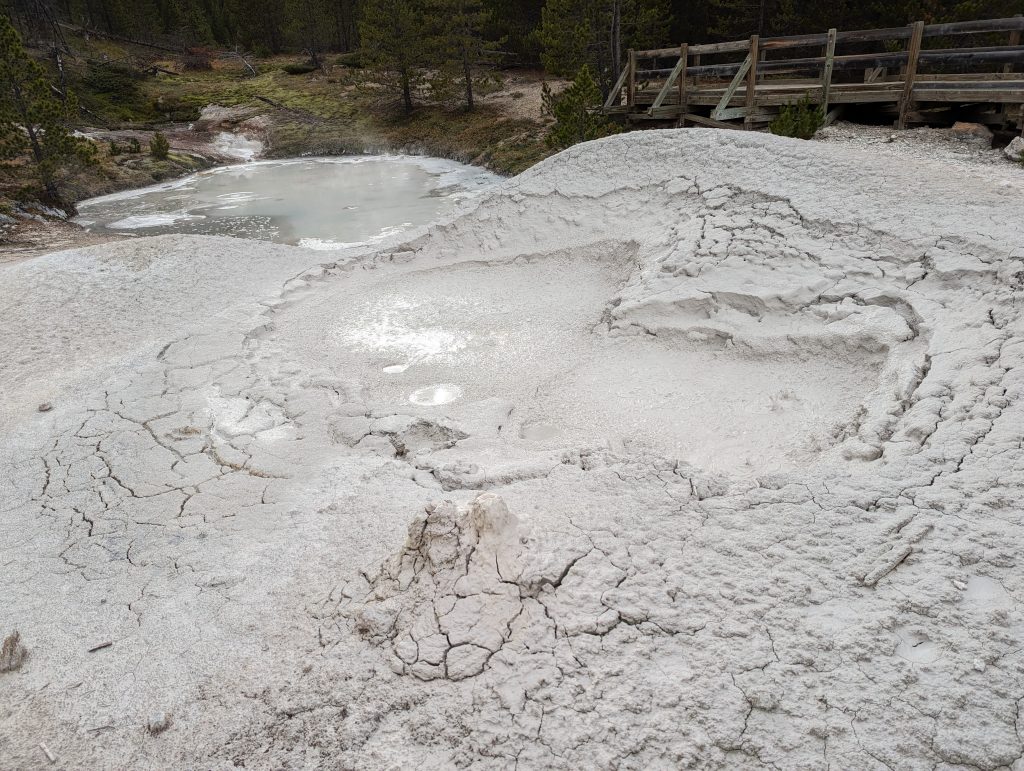
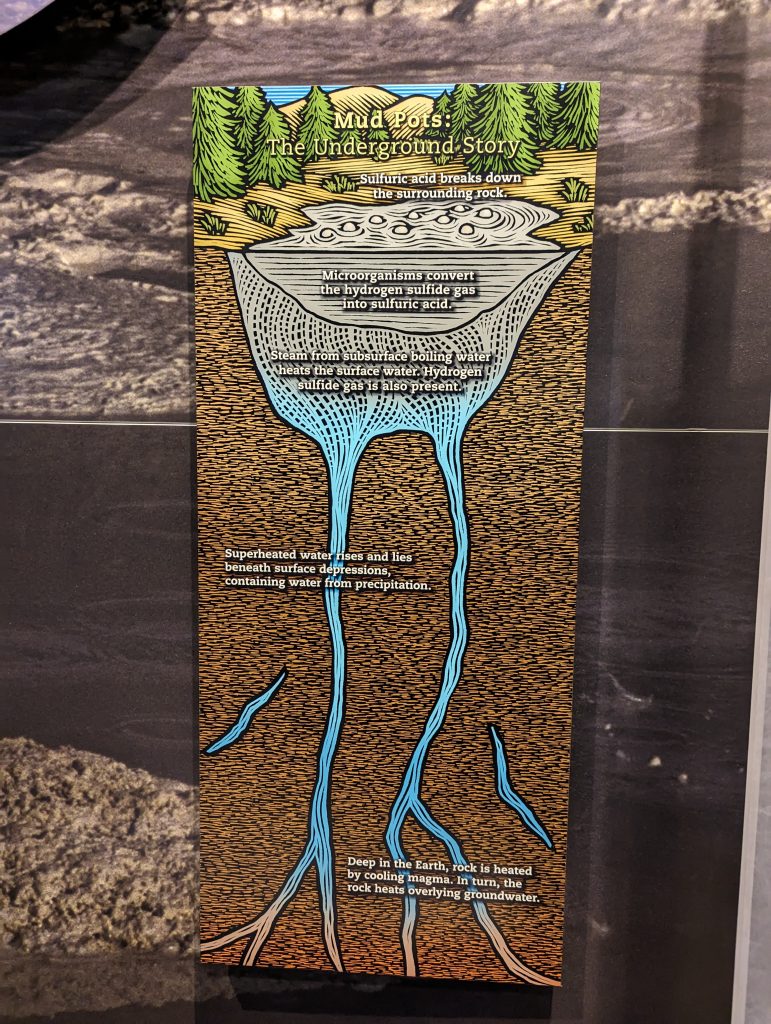
- Mud pots are similar to hot springs, hot rising water that accumulates in pools – however, in wetter seasons, such as autumn, these pools become silted up, leading to the appearance of bubbling mud pools at the surface.
- To make all of this clearer, the Visitor Centre has also provided pictures to explain the phenomena (see below):
- We were also lucky enough to see all of these thermal phenomena during our visit to the park.
- Leaving the Visitor Centre, we go straight to Old Faithful, which – as the name suggests – has very predictable eruption times – and an eruption is imminent, which cannot be overlooked in view of the crowds that have already gathered around the geyser.
- No comparison to the nice and quiet atmosphere we experienced in the morning
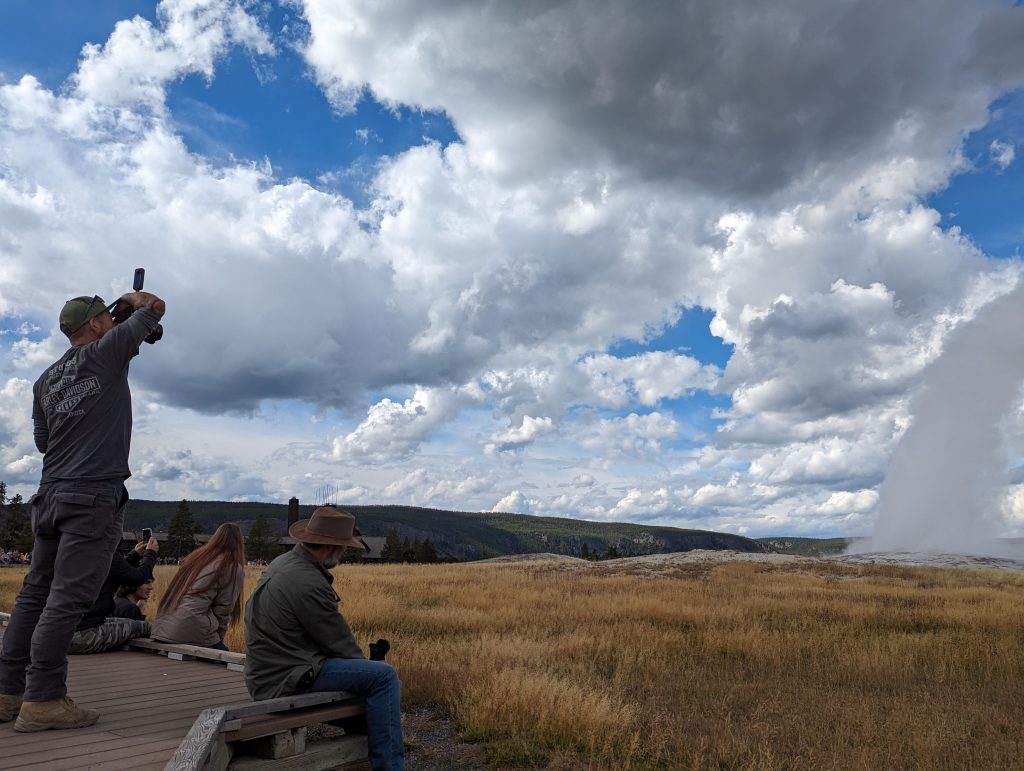
- As soon as the spectacle begins, the first people start clapping and it’s escalating quickly – in the middle of the action, a group actually starts to sing the national anthem- wow, America just like I imagined it…
- Via a wooden walkway we take a tour of the geyser landscape around the Visitor Centre, which is very impressive even without an eruption.
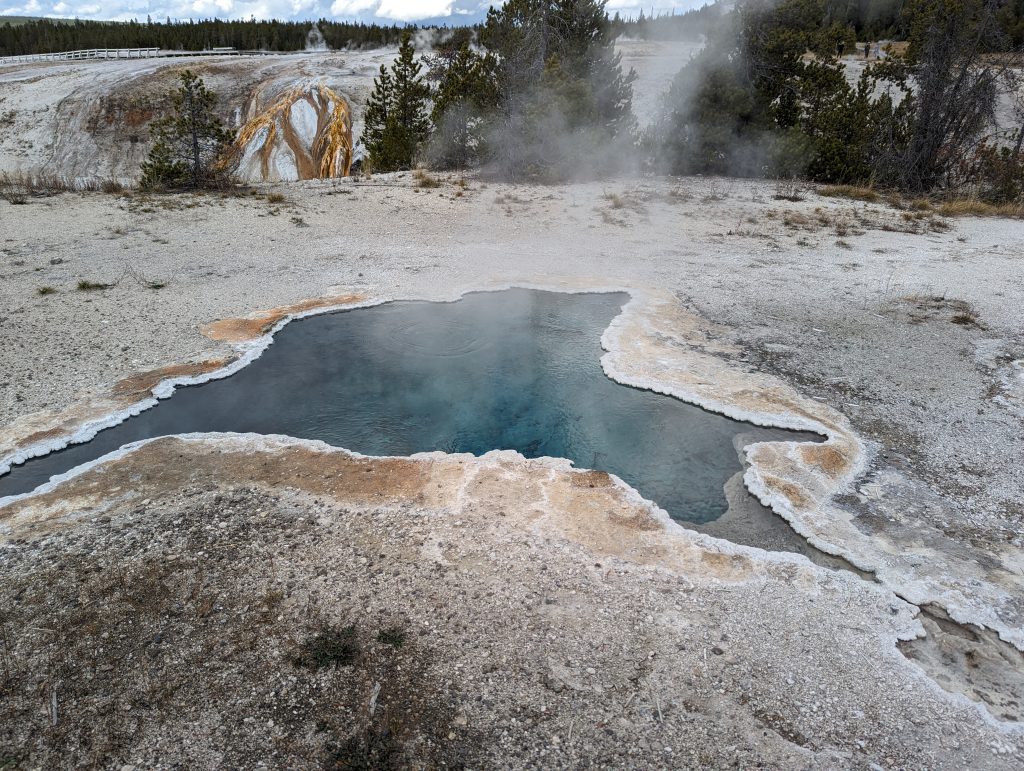
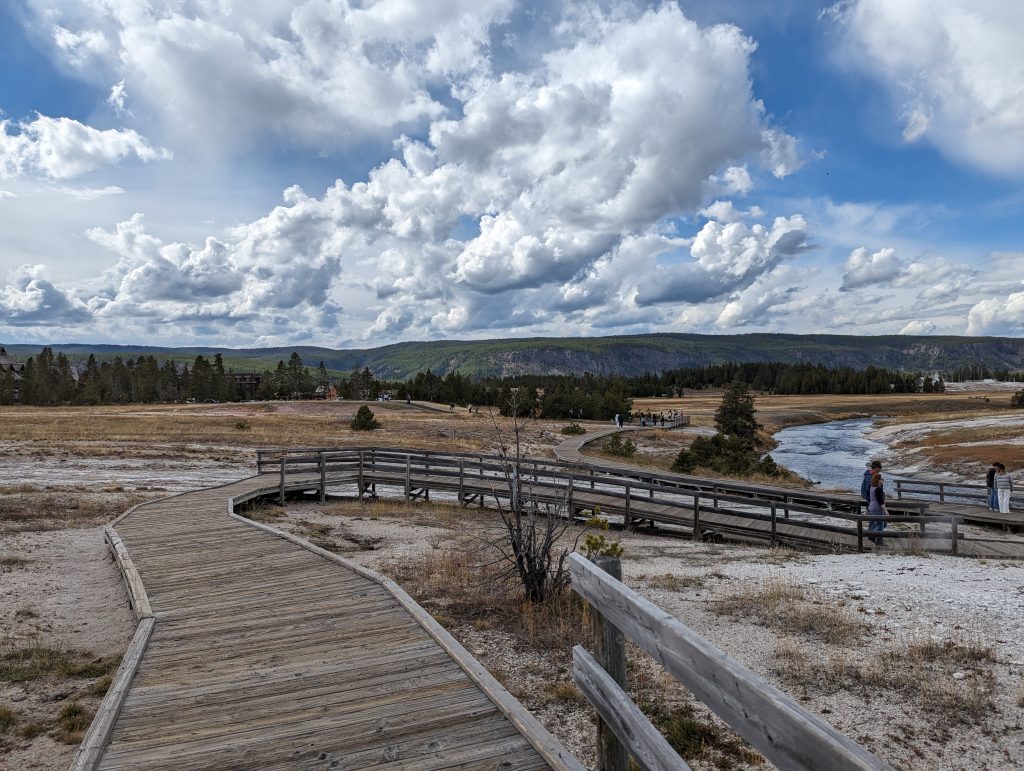
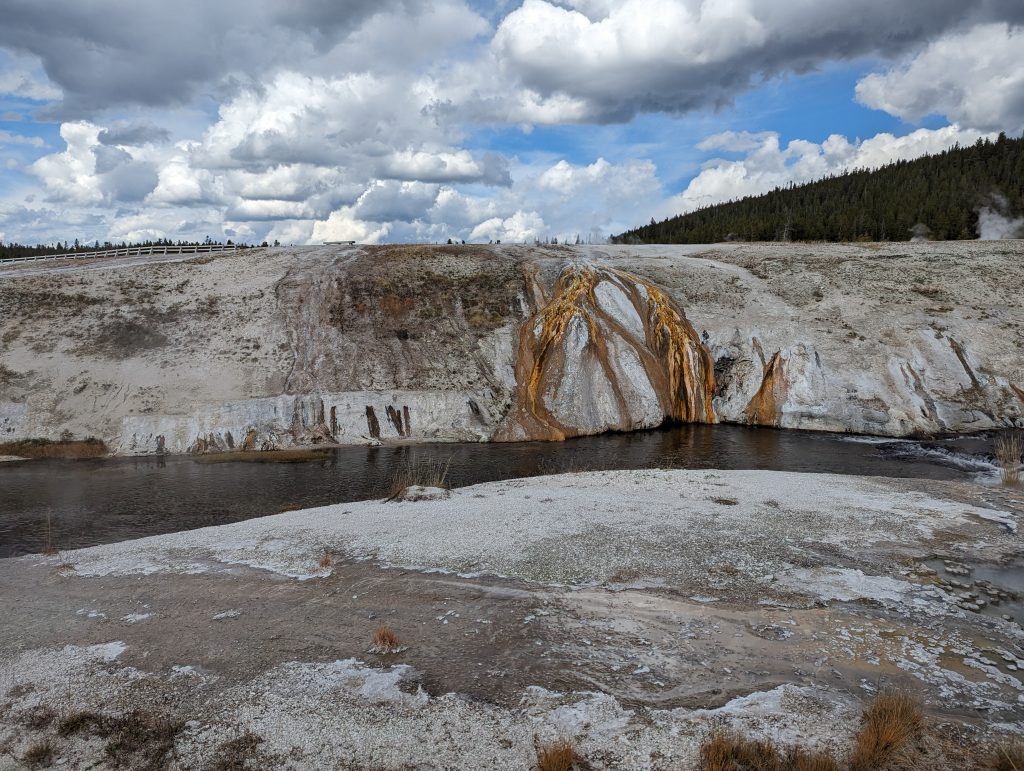
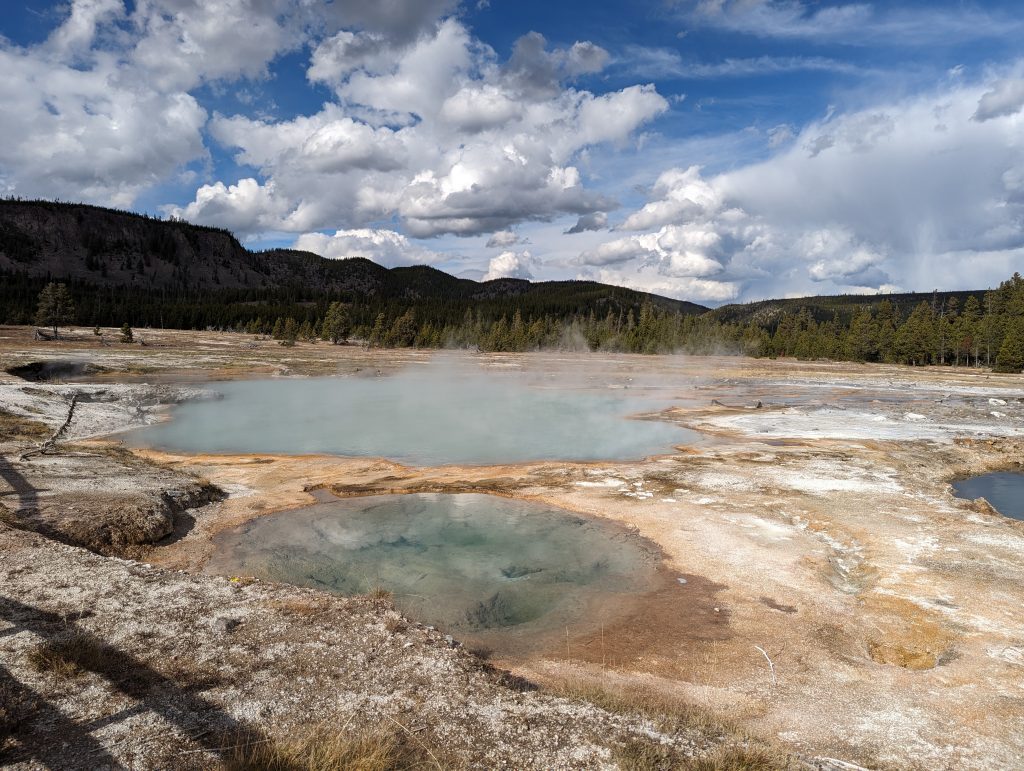
- By the way, here – more than in all other national parks – you have to be careful to stay on the paths, as there are dangers all around in the form of hot springs and quicksand. Matthäus mentions that visitors have already died because they fell into a hot spring.
- The hot springs are (which is rather unfortunate) not suitable for bathing- besides the fact that they are mostly very acidic they have temperatures of 70-100 degrees Celsius, which is not exactly a pleasant bathing temperature.
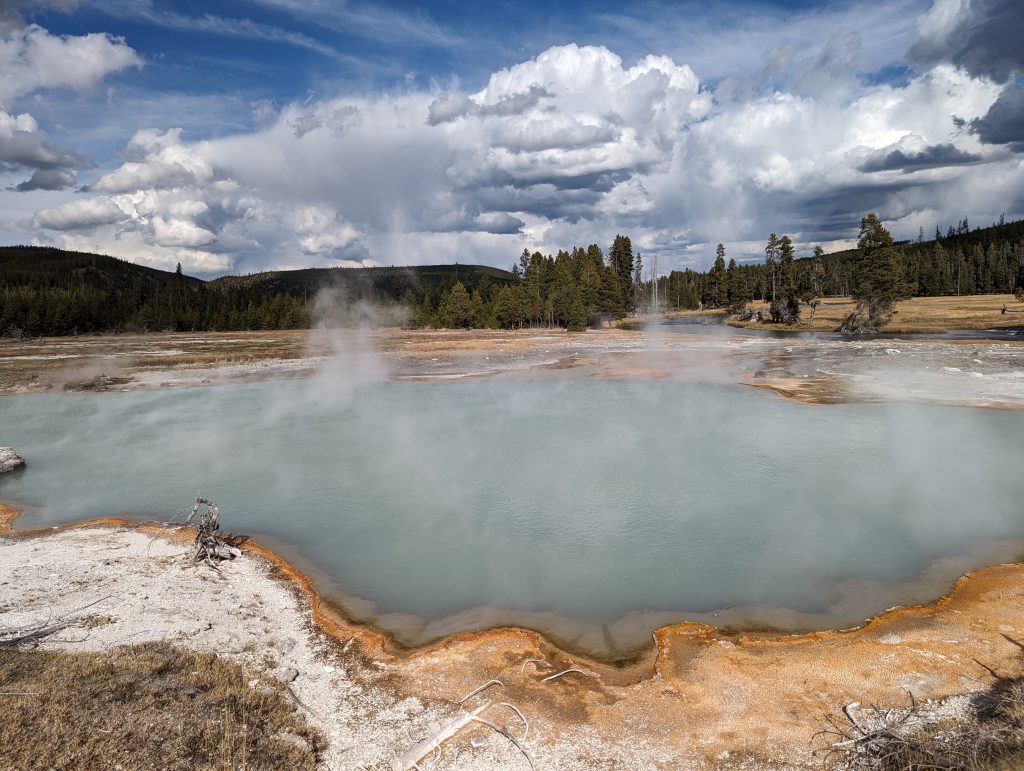
- We also read warning signs that one should not swim in the lakes of the national park, as they have temperatures averaging 44 degrees Fahrenheit, which is about 5 degrees Celsius.
- We plan to do the Grand Loop (by car about 230km) and stop at some hot springs along the way, including the Grand Prismatic Spring, probably the most popular photo motif in the park.
- By chance, we first discover the path leading up so that the huge hot spring can be seen from above and overhear visitors complaining: “I didn’t see any colour down there, so I had to climb up here now”.
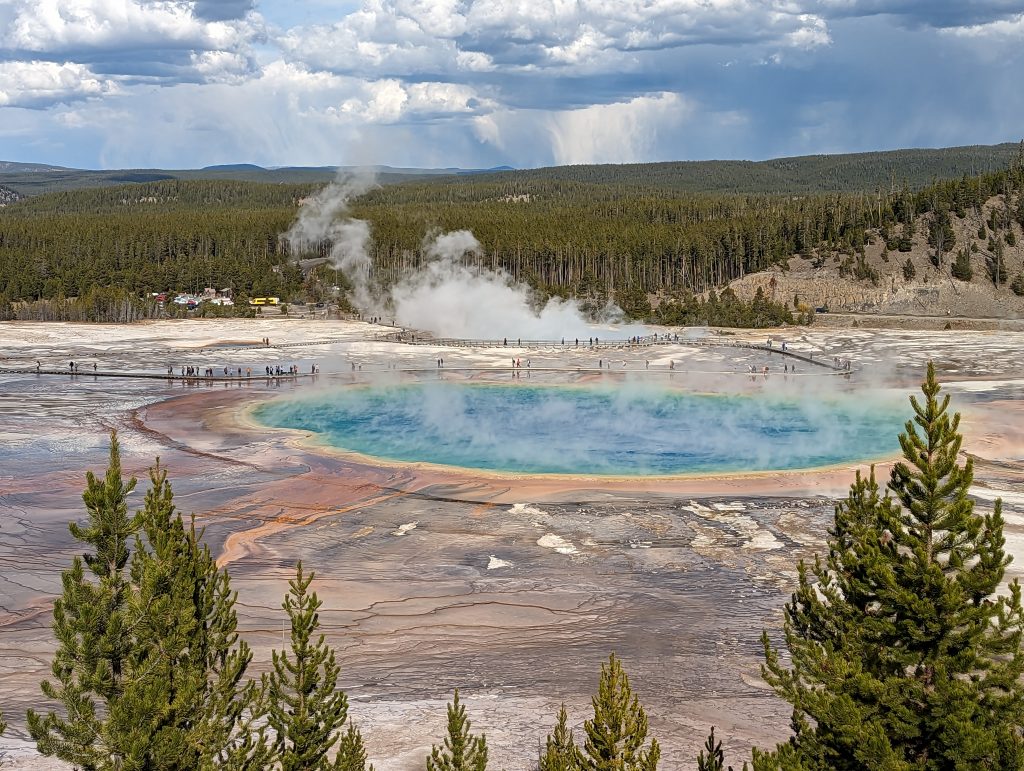
- In fact, the path is longer than expected and of course leads uphill (after all, we want to see the big basin from above).
- We come across a family with an “unmotivated teenage girl”, as Matthäus says, and really – she is the living picture of what you imagine an unmotivated teenage girl to be, wearing baggy jeans, a T-shirt, a jumper that hangs down to her elbows, dragging her feet across the ground with great effort and looking very grumpy- later we meet her again near the park exit and she looks a bit happier this time (“Probably the sightseeing day will be over soon”, Matthäus assumes)
- When we get to the Grand Prismatic Spring itself, we understand what the others meant – you can see and feel a lot of mist, but see little of the various colours in which the spring shines and which are created by bacteria.
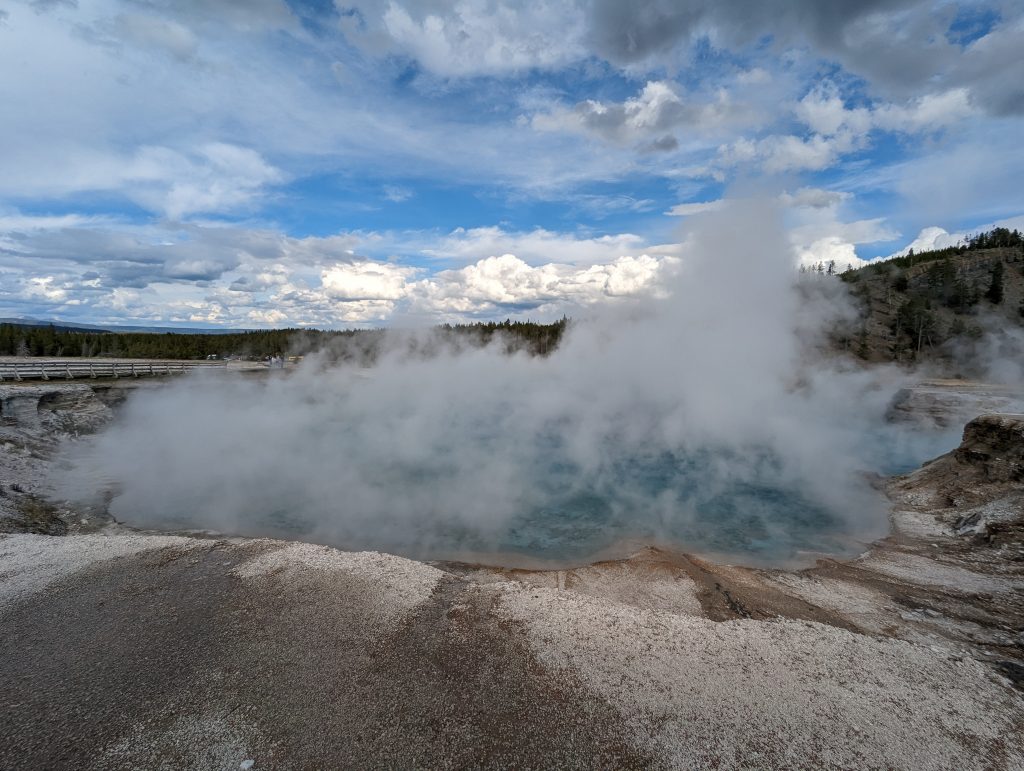
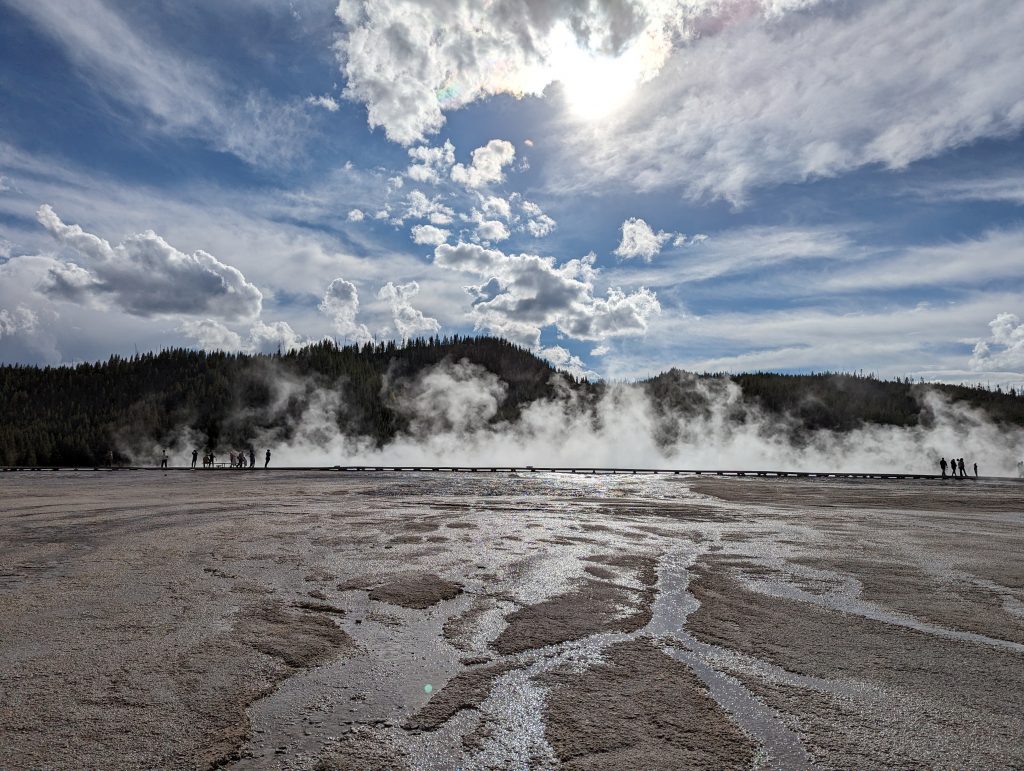
- The hot springs are, by the way, a great research source for research of extraterrestrial life, as the bacteria in them can survive in very hostile conditions.
- Feeling and smelling the vapours (you can smell the sulphur extremely, it smells like rotten eggs, mmh) is also an experience – you can feel how hot it is and when I briefly reach into the water that leads away from the spring in small streams – similar to those around the geysers – I realise how warm the water is even there – we experience the hot springs with all our senses so to speak
- We continue north and read up on thermal phenomena of the park, amongst thosemud pots and really at the very last moment we realise that we there is a spot where we can see them in the park
- It really is worth it, they bubble away in all sorts of colours
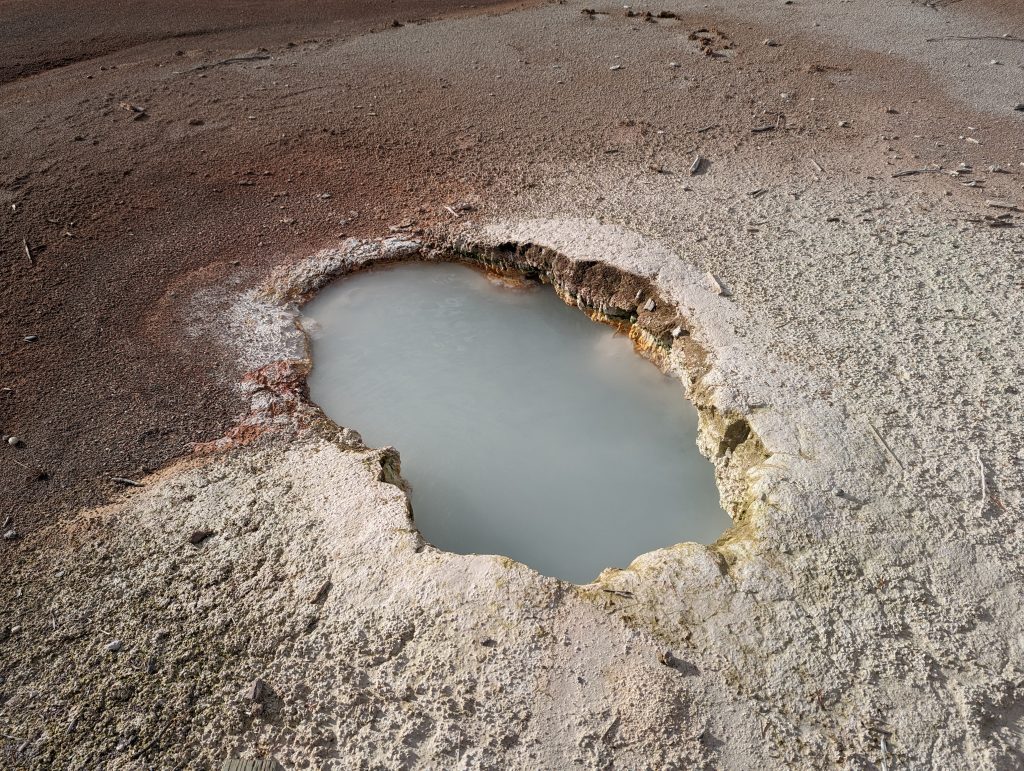
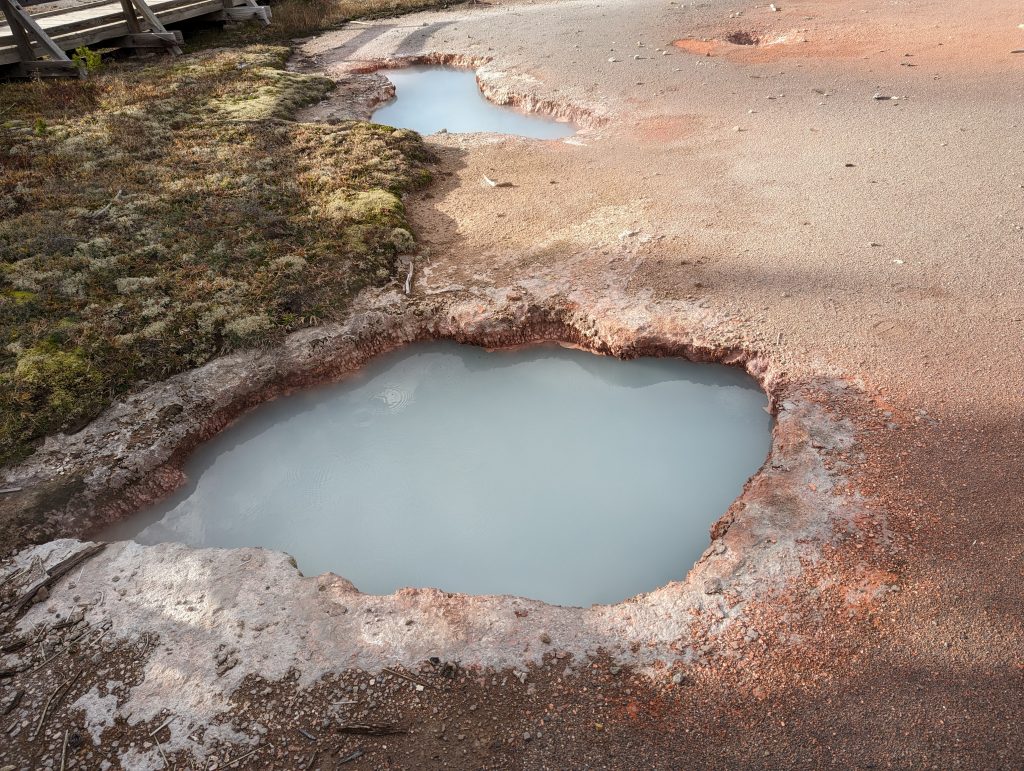
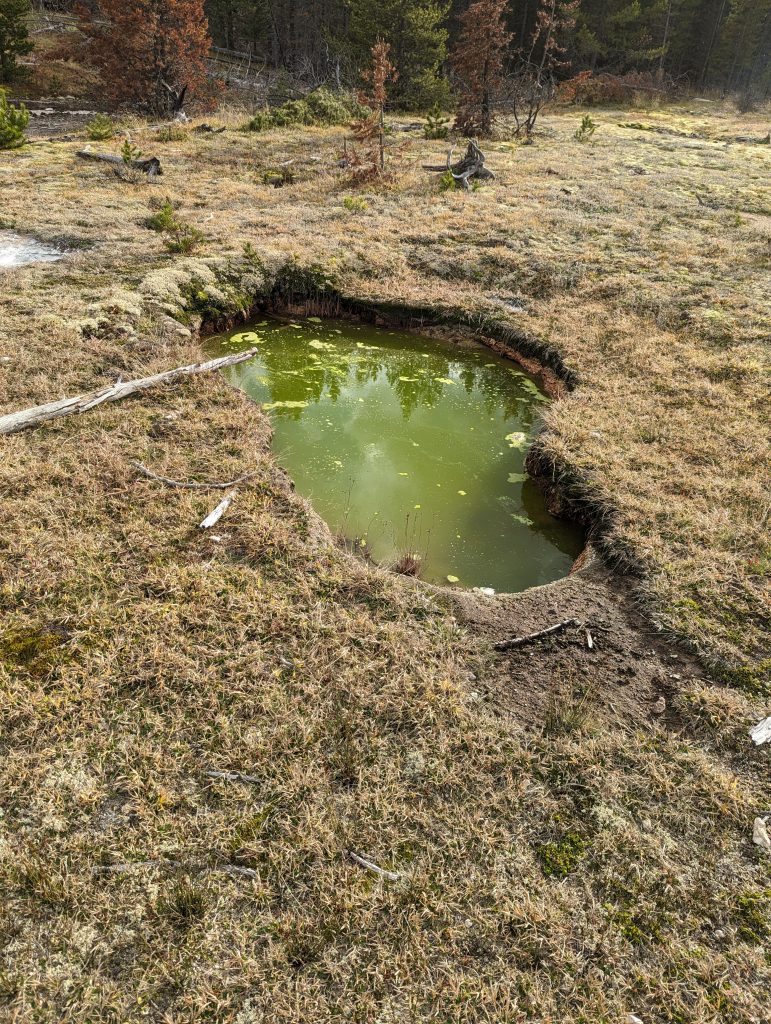
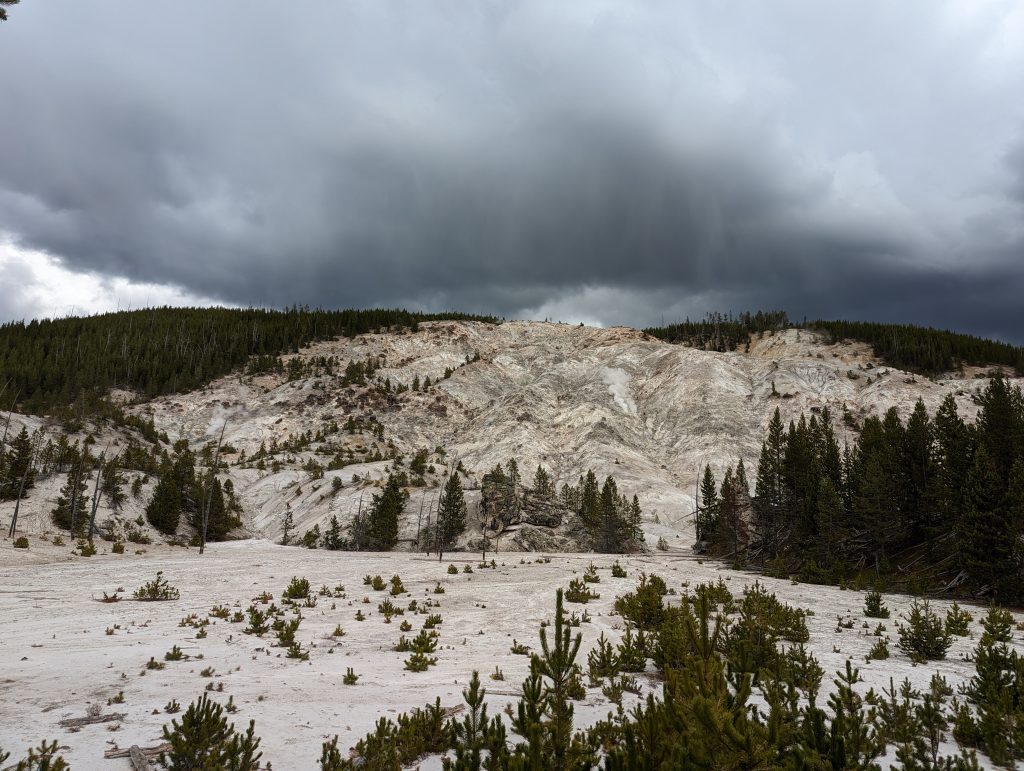
- The next stop is Roaring Mountain, so called because numerous steam vents erupt here, making hissing noises and giving the impression that the whole mountain is steaming.
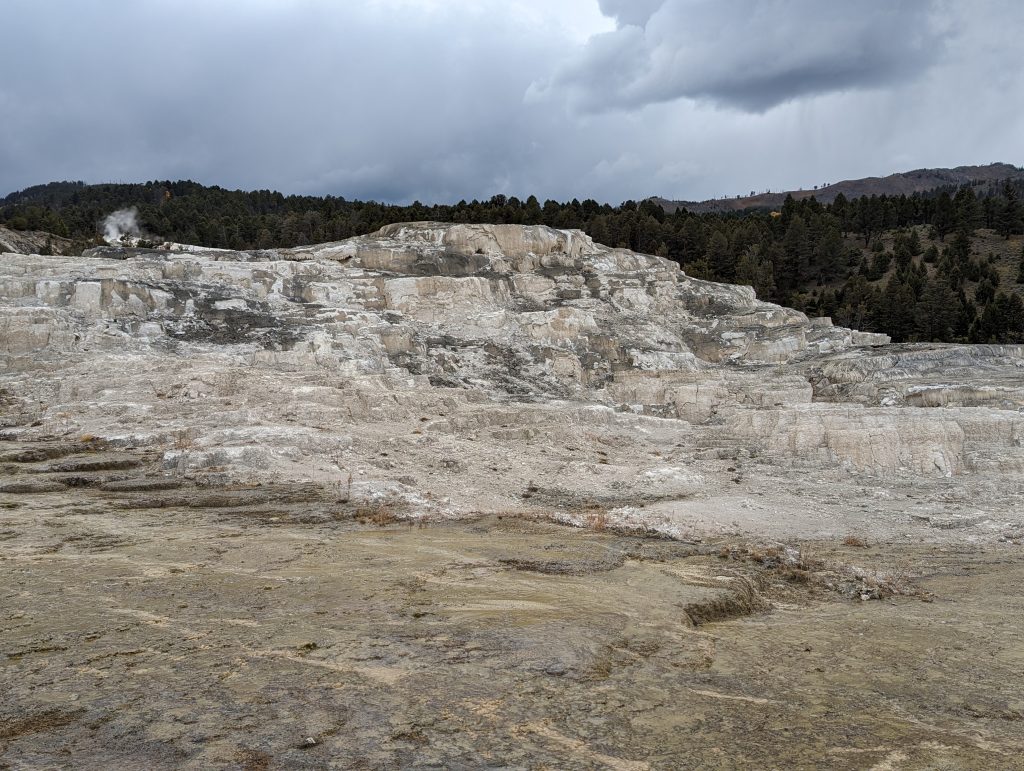
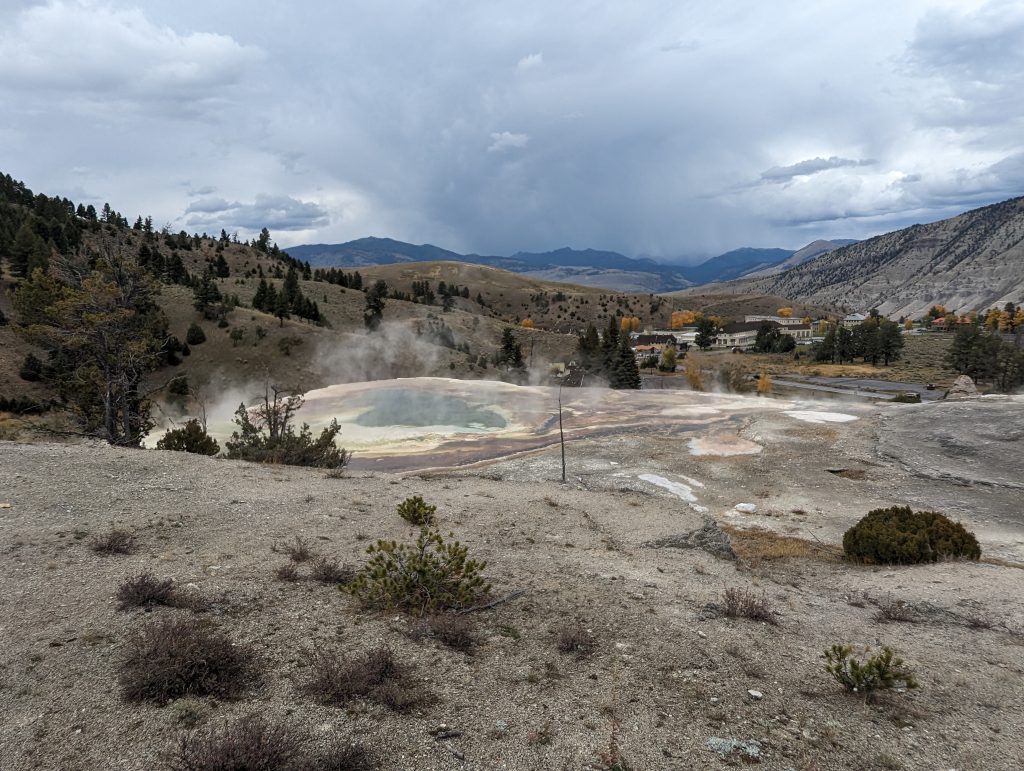
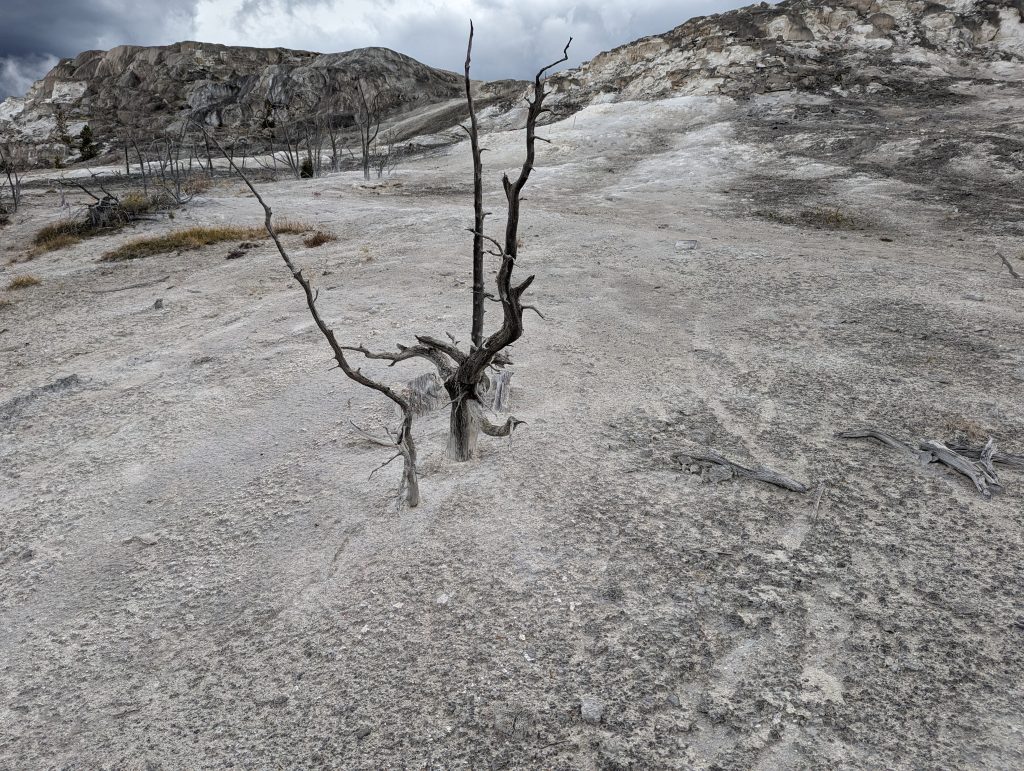
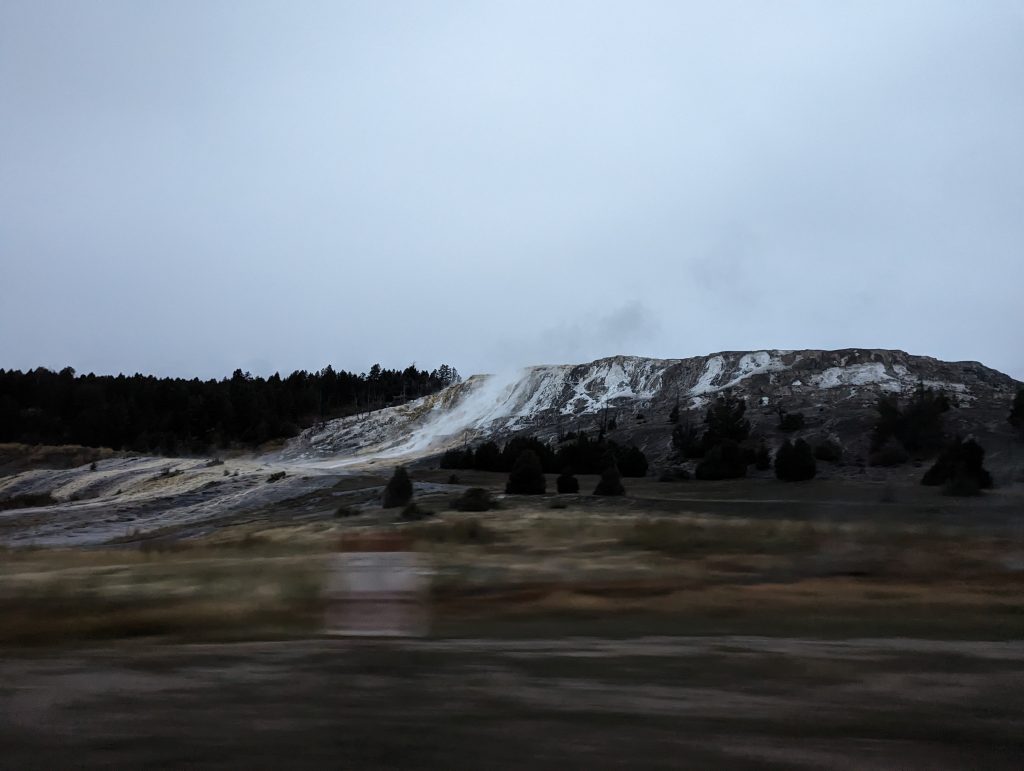
- The last stop is the Mammoth Hot Springs Terraces, where the hot springs have created a landscape of terraces and crazy colours, including snow-white hills.
- Finally (it is already evening) we reach the Albright Visitor Centre, the only place in the whole national park where there is internet (otherwise there is neither WLAN nor reception).
- This is good, because we still have to book accommodation for tonight, which we do right away
- We decide to stay in Gardiner, which is very close to here at the park’s north entrance, and see a bit more of the national park tomorrow before we start on our super long drive to Boulder.
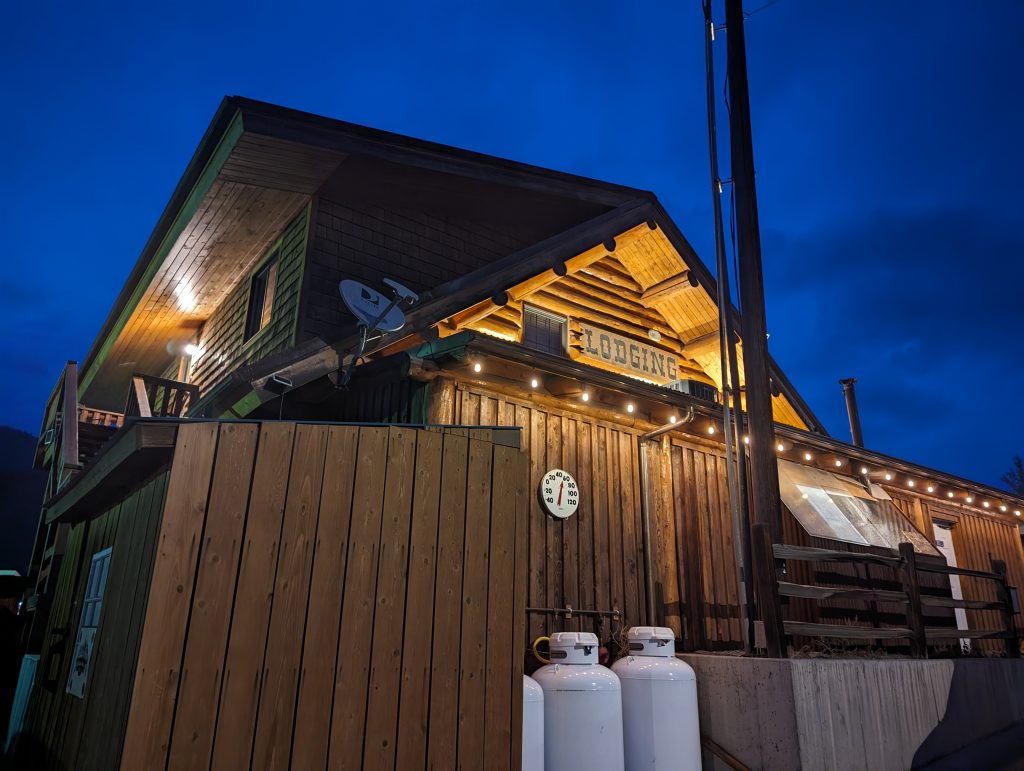
- There we find a nice place to stay, the Cowboy Lodge
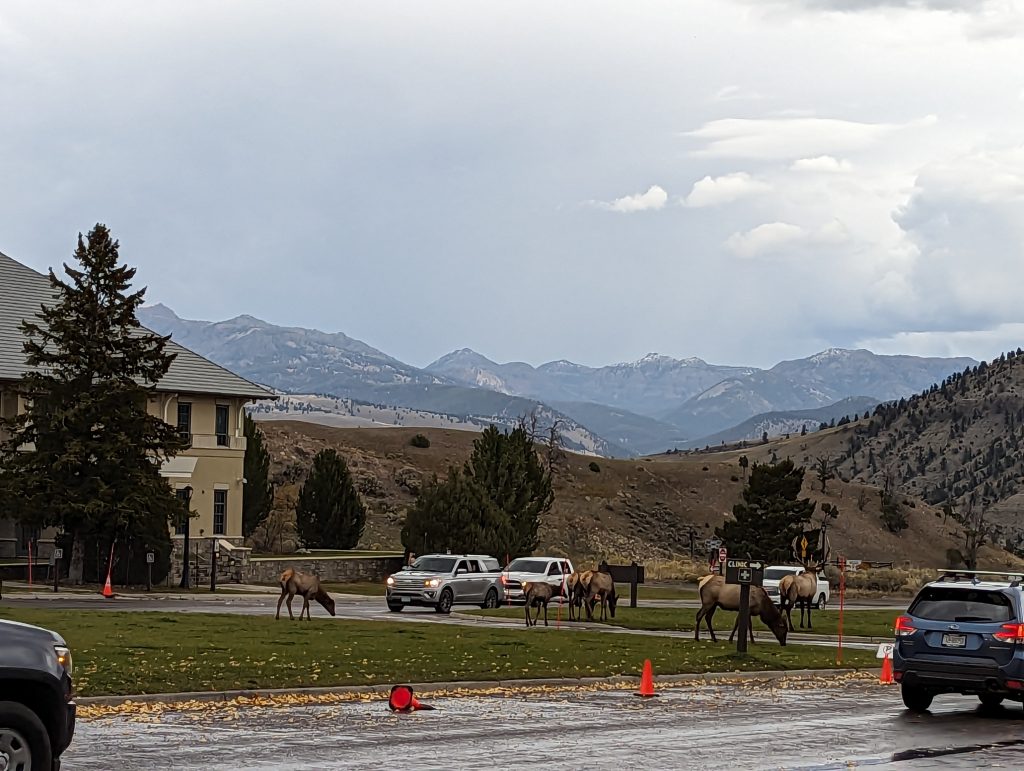
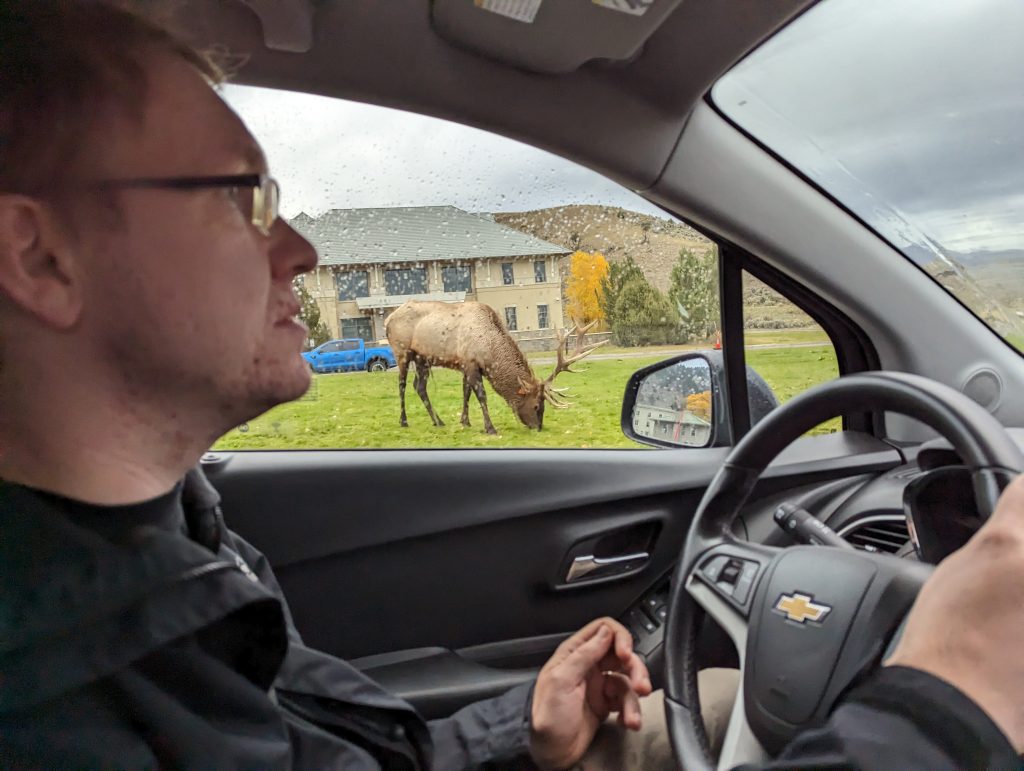
- On the way there we see a whole herd of Wapiti, which has made itself comfortable on the main square of the small town, causing all traffic to stop, especially since all the tourists want to stop to take photos – which in consequence leads to several rangers being present trying to shoo the tourists away from the animals
- We find out that there are only restaurants without to-go nearby, and since we want to chill in our room, we drive in full American style to a nearby pizzeria, where we get pizza to go.
- Comfortably chilling in bed and watching a grizzly bear and Yellowstone National Park documentary, we enjoy the amazingly tasty pizza before we fall asleep
Wednesday, 11.10.
Winter storm und Heavy thunder storms expected
- Again we start early, firstly to see the national park in the morning light and secondly to escape the winter storm that is announced for this afternoon/evening
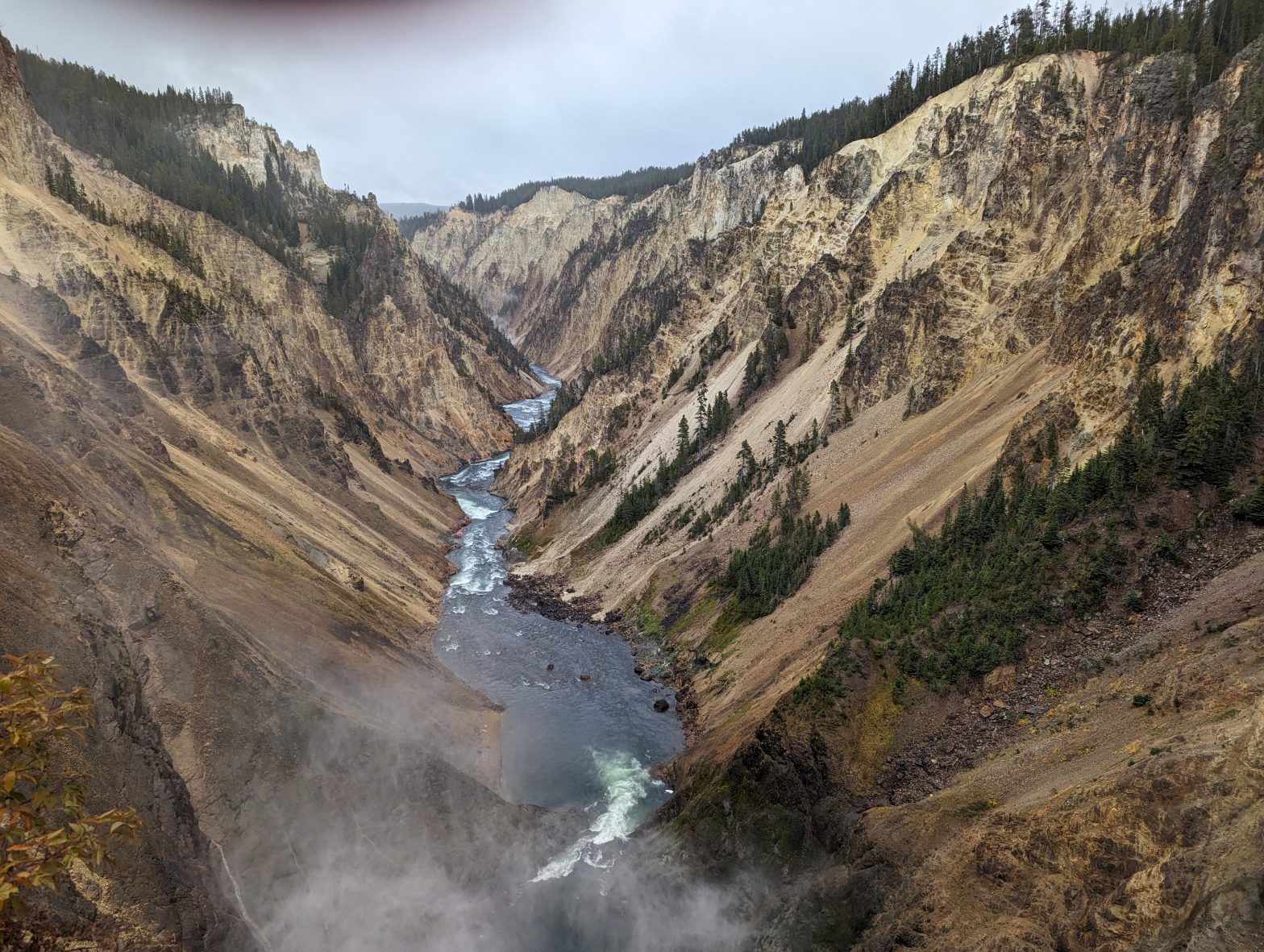
- Off we go into the park and to the Grand Canyon of the Yellowstone, a large canyon that the Yellowstone River has carved out of the rock here – this is particularly worth seeing as the river plunges through the gorge via two large waterfalls.
- The landscape is still being altered thanks to hot springs that soften the rock and thereby allow the water to carve out new pathways
- We walk down the short but steep trail to see the Lower Falls from above
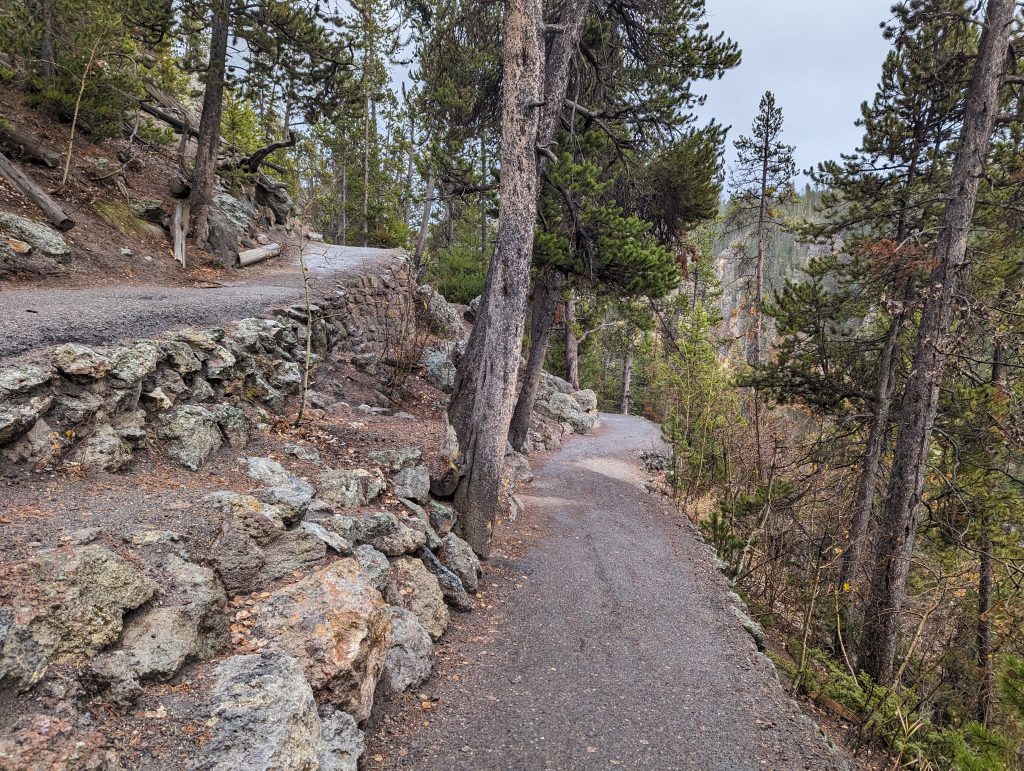
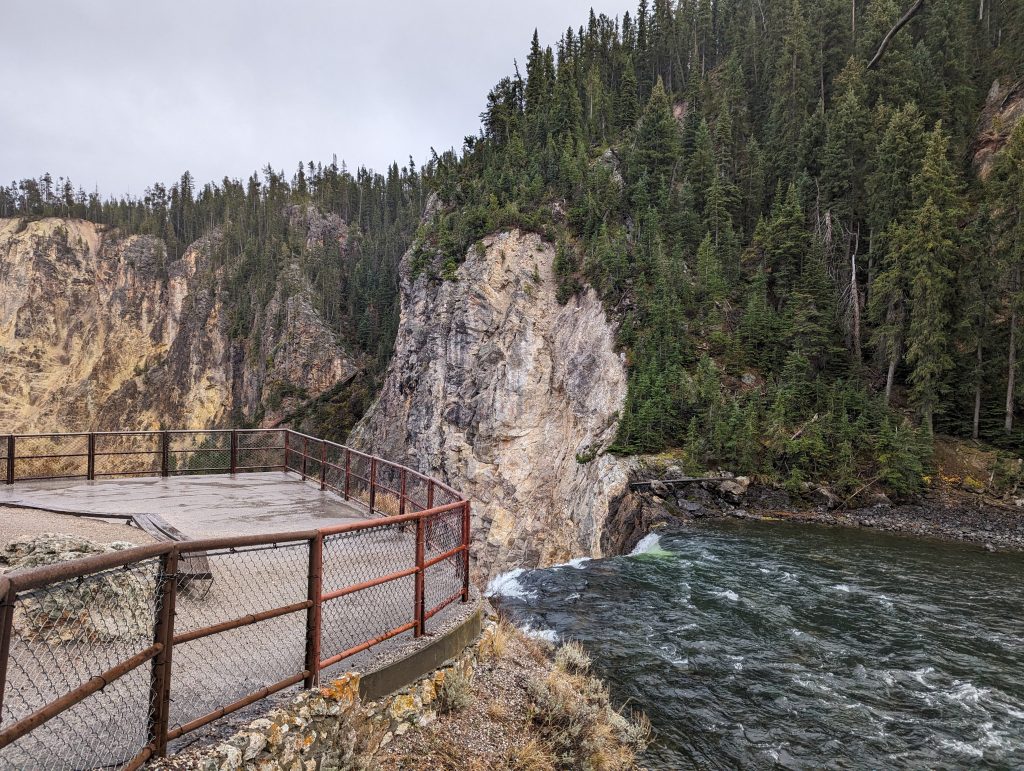
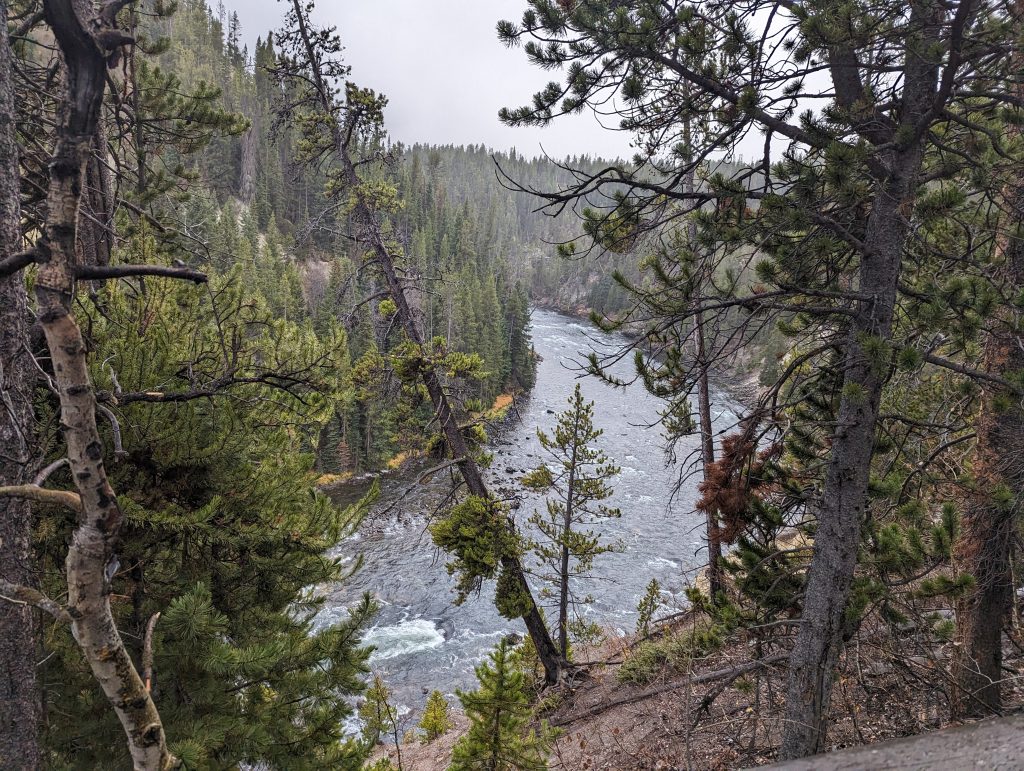
- The Lower Falls are the taller of the two falls, at 93m high (the Upper Falls are 33m high).
- It is amazing and at the same time a little scary to stand at the top of the falls and watch the unbelievable masses of water plunge into the depths.
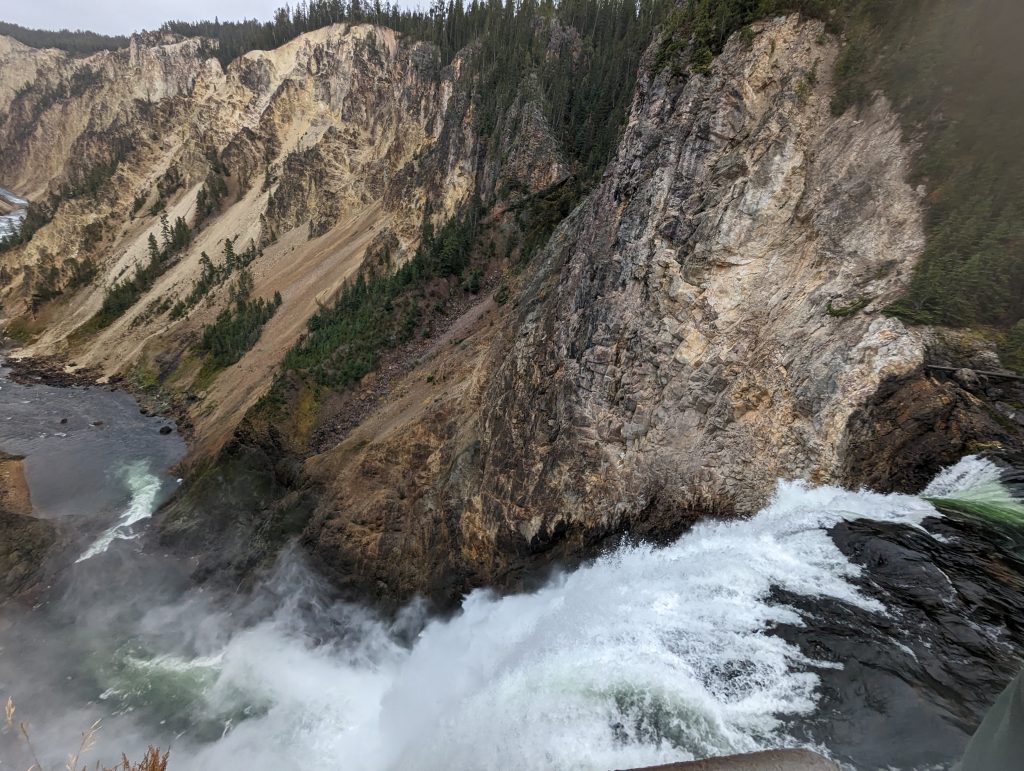
- The canyon itself is also a sight – it is much narrower than the Grand Canyon, but the rock glows in all kinds of colours, dominated by yellow, which also gives Yellowstone its name.
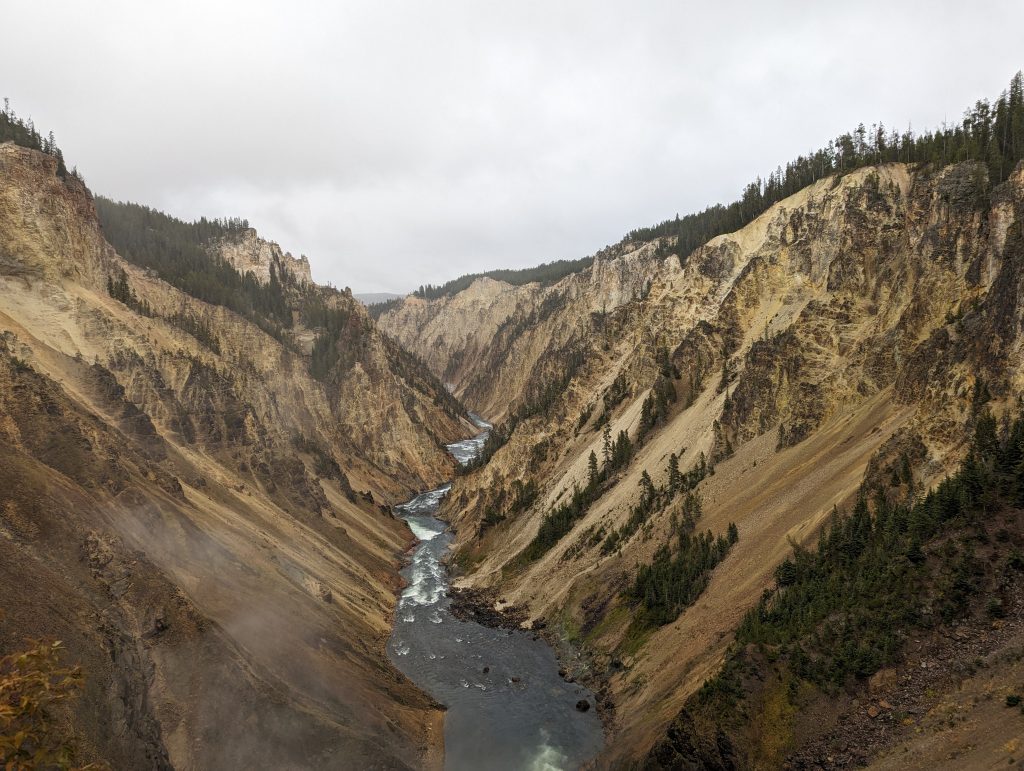
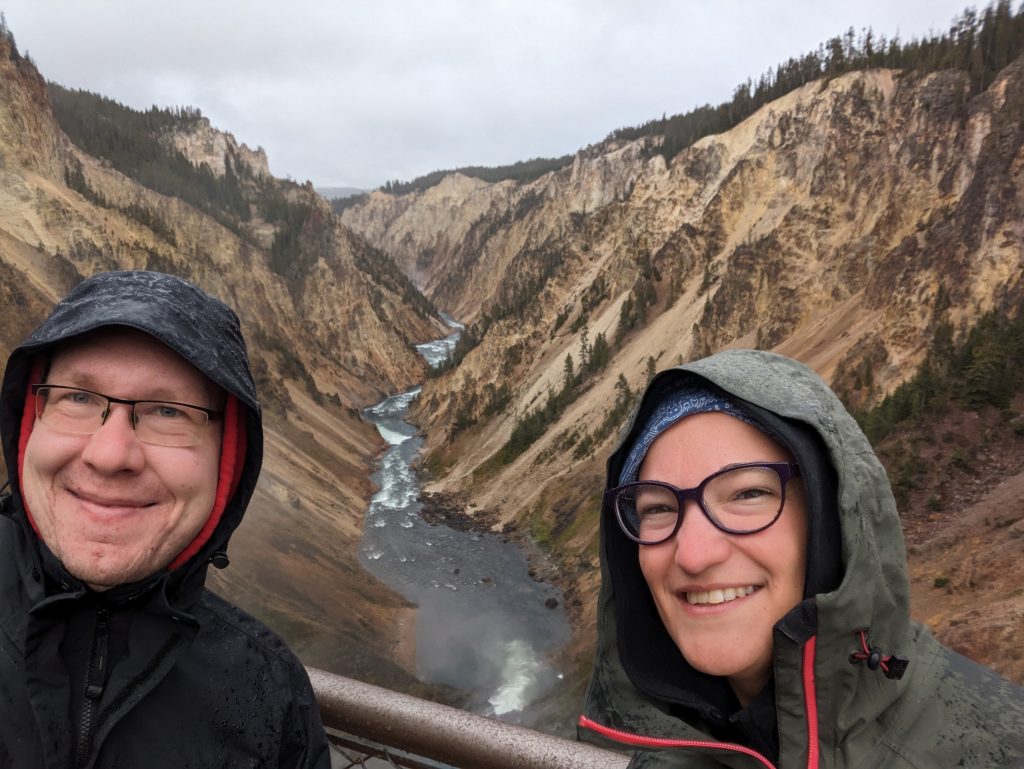
- We stop at several view points, to see the Upper and Lower Falls – the most impressive of which is certainly Artist Point, from where you can see the Lower Falls very well.
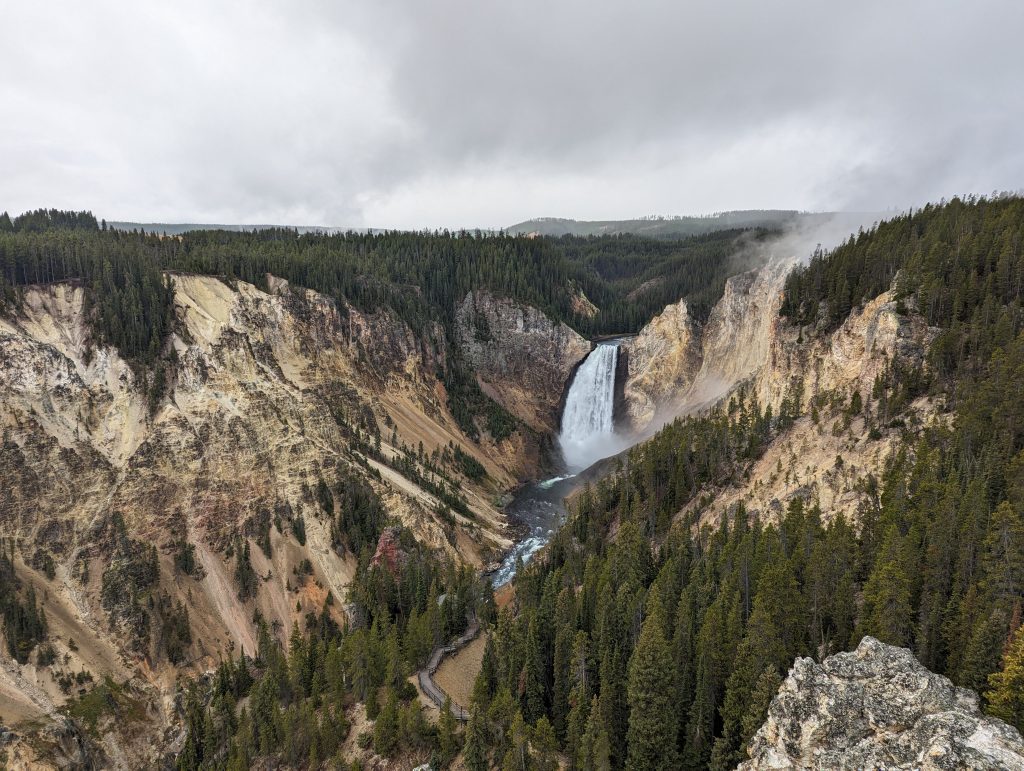
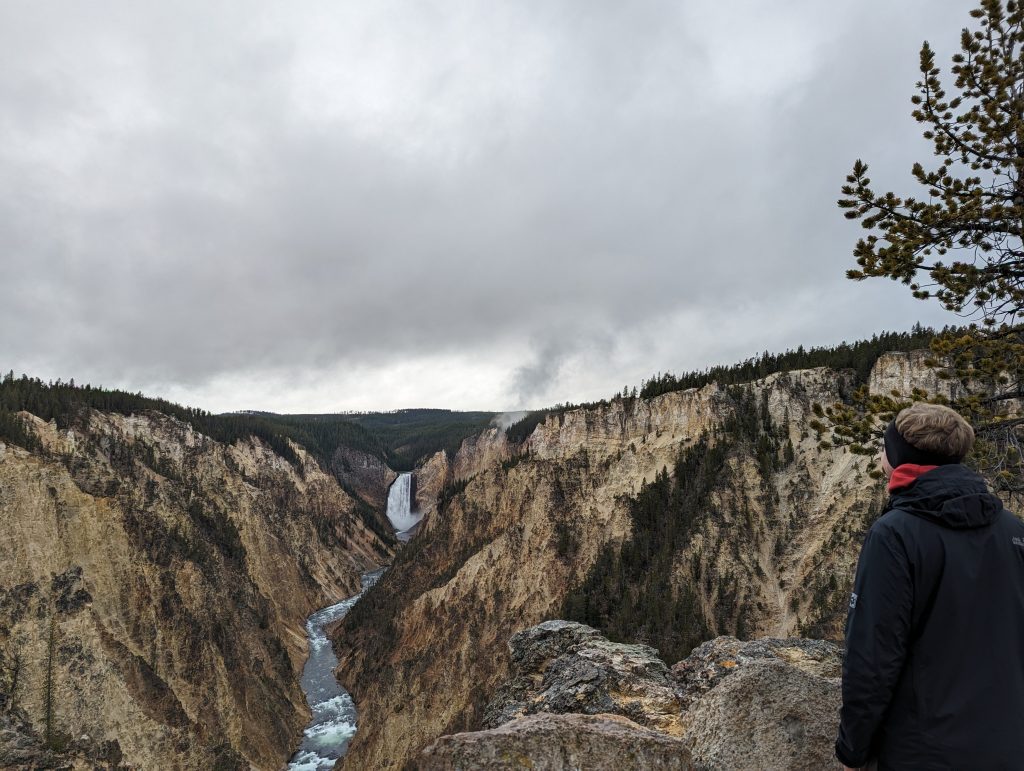
- On the way there, during a toilet and sightseeing break, a group of Spanish tourists asks me: “Where can we see the canyon?” and I patiently explain to them from which view points one can see what and where they should best stop, “are the people really so unprepared?” Matthäus asks incredulously.
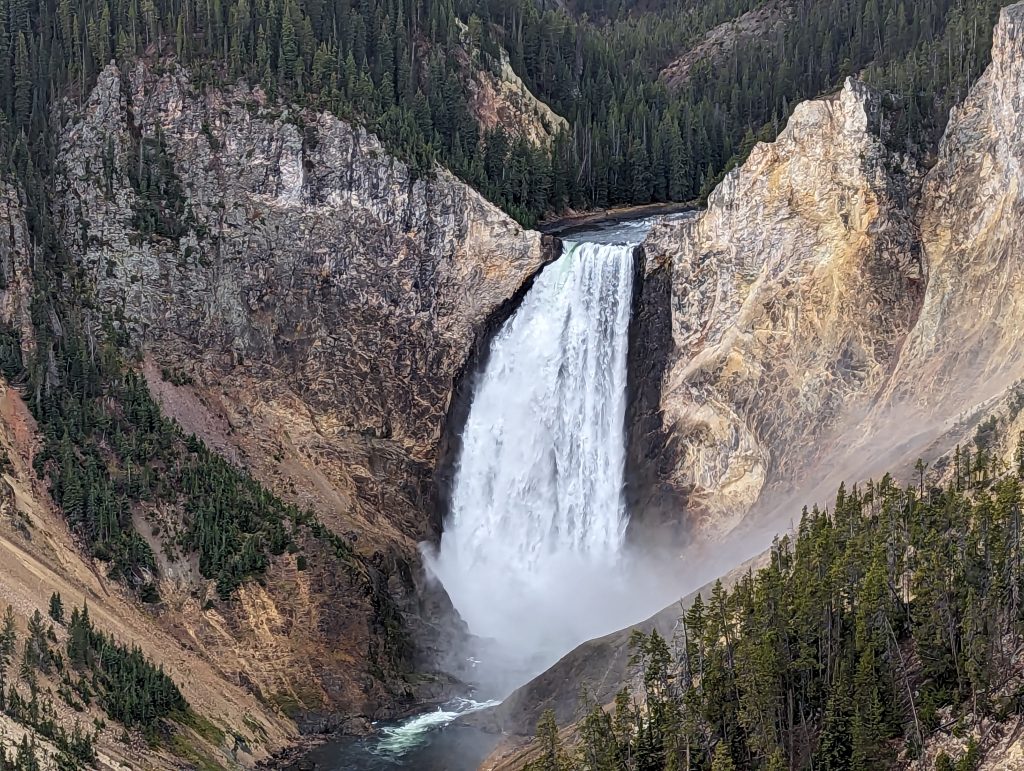
- By the way, it is a rainy day, sometimes it drizzles and while driving we even see snowflakes in some places – and Google keeps warning us of a “Severe Thunderstorm” and “Winter Storm” – great!
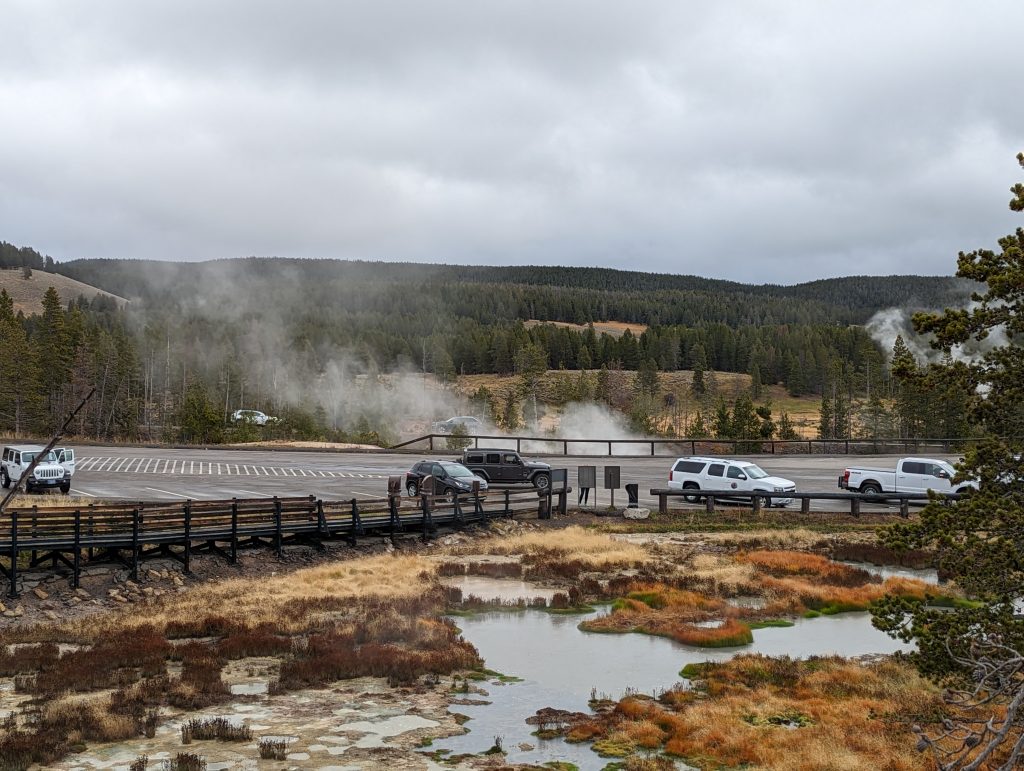
- Now it’s time to say “Goodbye Yellowstone”, and we make our way out of the park, not without making a few small stops at hot springs, mud pots and the lake, however.
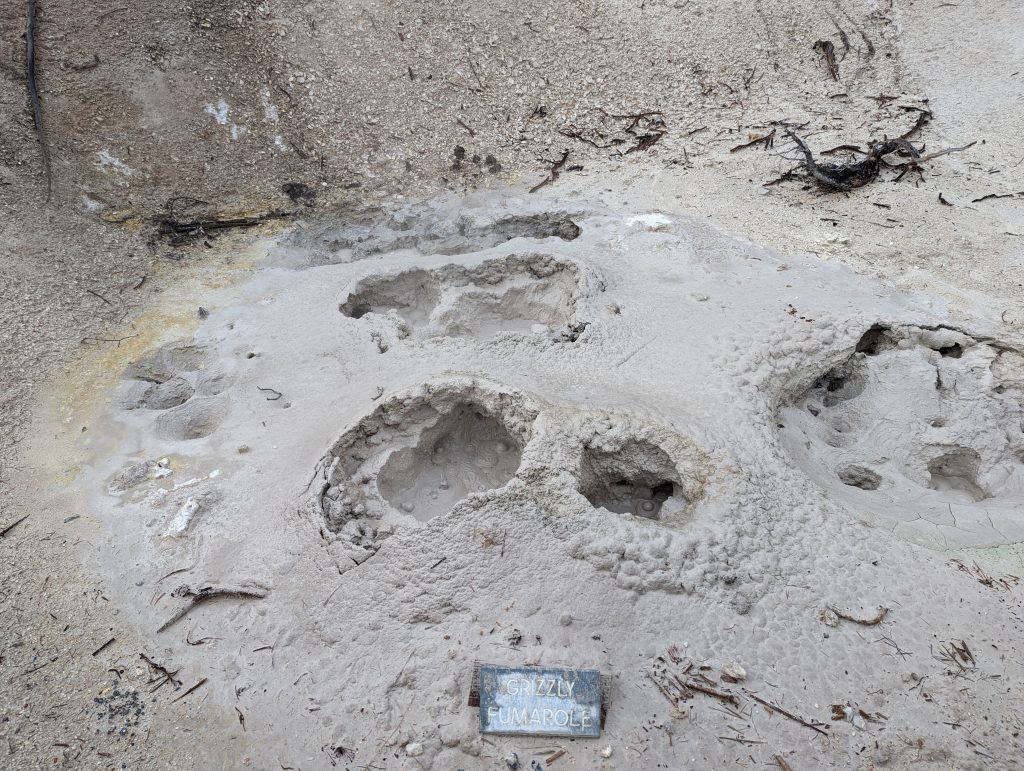
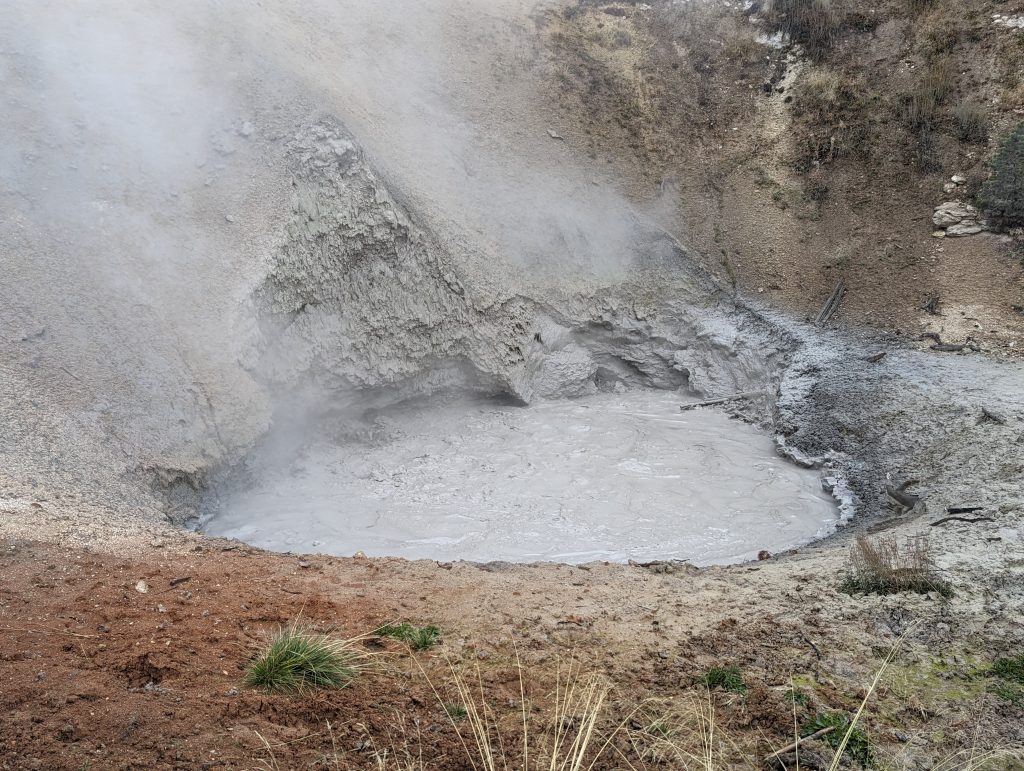
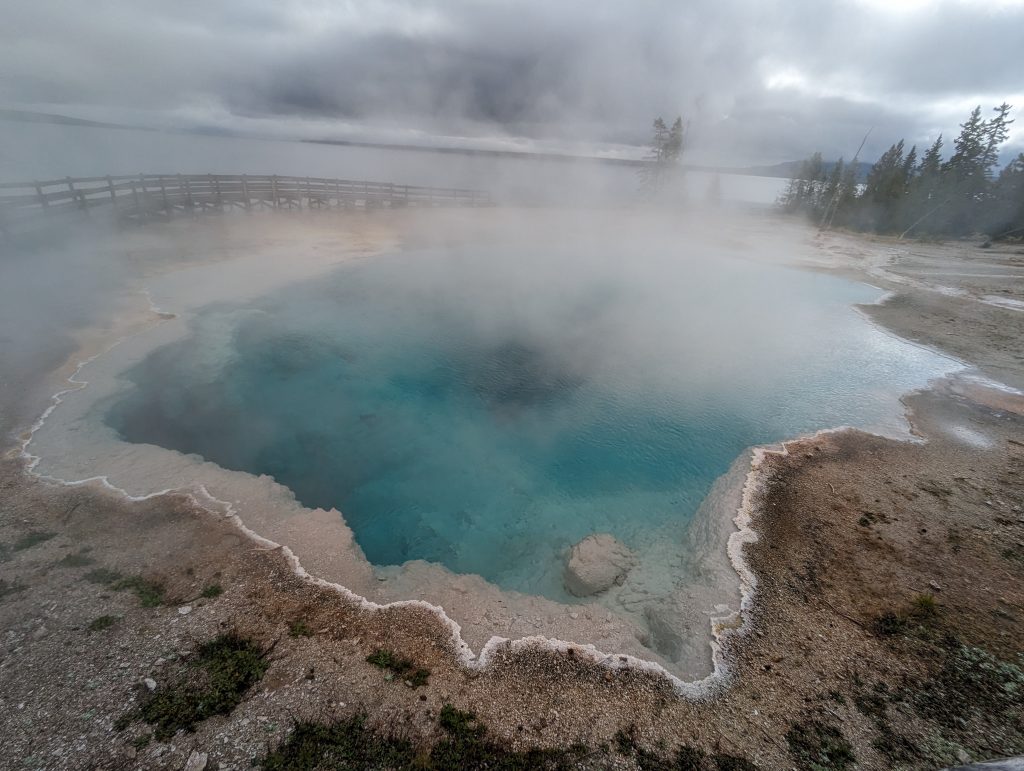
- The most impressive hot spring (in my opinion) we see is Dragons Mouth Spring, which lives up to its name, but see for yourself in the video below.
- Through the Grand Teton National Park we head south again!
- Driving through an Indian reservation, no internet reception, no GPS, no octagonal houses but caravans, not really cheap petrol stations and a fancy casino that looks lost in the lonely and barren landscape.